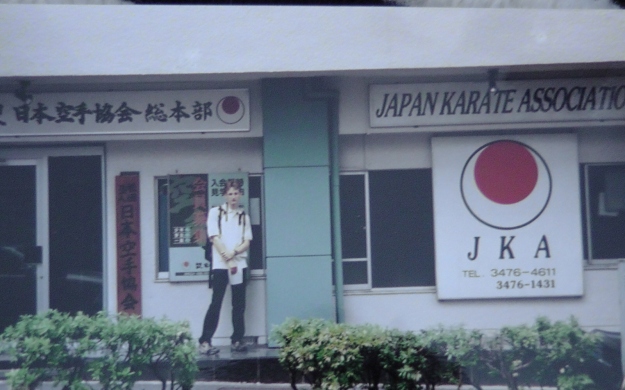
The reason for the numerous associations and federations in karate lies primarily in its nature. The number of active karateka increased significantly when various masters began to accept more than a handful of students and karate was introduced into school education at the beginning of the 20th century. With the spread of karate to Japan and the subsequent internationalization by Japanese associations and former GIs stationed in Okinawa since the mid-1940s, this development accelerated. After all, everyone wanted to represent their school, and many claimed to be the legitimate successor of their teacher. A phenomenon that runs through almost all karate styles.
The genealogy of karate associations paints a clear picture. For the example of karate, which can be traced back to Funakoshi Gichin (1868–1957), there are a large number of organizations at both international and national level.
The co-existence of numerous national and international karate associations and the competition between them is probably one of the main reasons why karate, as a “combat and martial arts sport”, has only in 2021 been admitted to the Olympic Games as a sport.
The question can now be asked as to what motivated karate to break away and go its own way with its own organization. Is it political or financial reasons? Or is it simply a difference of opinion about the teacher’s understanding of the style and concept?
If one uses the Japanese martial art concept of “shuhari” 守破離, i.e. the stages of development in learning a discipline to mastery, as a justification, there is another approach as to why a student separates from his roots. It is said that the “shu” stage is primarily about learning techniques and forms. The student accepts what the teacher shows him. In the next stage (“ha”), the student now develops the techniques learned more freely. He develops it further. Finally, “ri” is about letting go. He makes his own experiences and becomes increasingly independent. Gradually, he separates himself from his teacher. Following this tradition, at some point he must inevitably separate himself from the teacher-student relationship and possibly from the organization that provides him with a home.

 Investigations into the history of karate
Leave a Reply