For the academic study of karate, it is also important to think outside the box. I always look to see what’s new on the market and what scholarly approach the authors have chosen for their research of other martial arts disciplines.
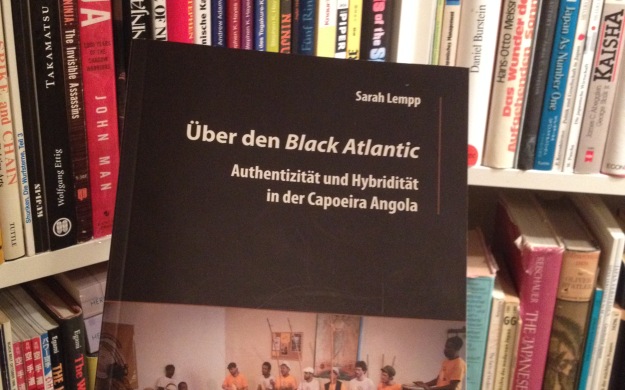
Compared to other body cultures such as the Olympic martial arts disciplines of jūdō and taekwondo, Indian yoga or Western-style bodybuilding, capoeira is largely unknown to the general public. It is only since the 1980s that the Afro-Brazilian martial dance has been slowly gaining in popularity. This also applies to the scientific study of this form of movement. Sarah Lempp’s master’s thesis, entitled “Über den Black Atlantic. Authentizität und Hybridität in der Capoeira Angola“ (About the Black Atlantic. Authenticity and Hybridity in Capoeira Angola), published in the Ethnology series by Tectum Verlag in 2013, is also dedicated to this cultural phenomenon. She explores the question of “how capoeira Angola players [in Germany] make use of the complex network of dance, music, forms of movement and mythology and how capoeira changes in the process”. She also takes a look at the role of capoeira as a “black resistance movement” and in the “market for ‘exotic’ leisure activities”.
The book is structured in such a way that, after introducing the topic and the central question, the foundation is laid for the academic study of the research field (pp. 9–20). The author then gives an overview of previous ethnological work on capoeira with the aim of placing her work in the academic discussion (pp. 21–27). This is followed by an insight into the history of capoeira in order to place the topic in its historical context (pp. 29–45). After narrowing down the field of research (pp. 47–55), explaining the methodological approach (pp. 57–67) and interpreting the empirical material from an internal perspective (pp. 69–91), the author concludes with a discussion of her findings in relation to authenticity and hybridity (pp. 93–113) and with her final observation (pp. 115–122). A glossary and an extensive list of sources round off the work.
The essence of Lempp’s academic engagement with capoeira and the attitudes and experiences of selected capoeirista, whom she interviewed for her study, is an analysis of the understanding of cultural translation processes – albeit limited to a micro-perspective. There is no additional look at a wider context and this would certainly not have been possible in the context of a master’s thesis. In any case, this in no way detracts from the value of this work.
Lempp succeeds in presenting a generally understandable and readable ethnological study in an excellent way – within the framework of her work. The author herself became acquainted with capoeira during a study visit to Rio de Janeiro, so she has gained not only theoretical but also practical experience, which is useful to her in dealing with the subject matter. In addition, the author draws on original language sources, which further enhances the value of her work. Sarah Lempp’s book is unreservedly recommendable – for the active capoeirista, the interested martial artist as well as for the ethnological and hoplological researcher.

 Investigations into the history of karate
Leave a Reply