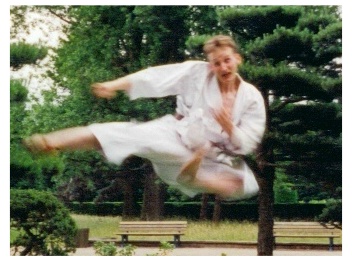
Recently a video was published about the supposed influencing factors of high kicks in karate. The theory is interesting, the video very entertaining. But there is a lack of historical evidence.
There are so many myths and legends in the world of martial arts. For many years, serious efforts have been made to explain historical backgrounds and uncover falsehoods. However, the research and its results, some of which has been carried out by professional academics at universities, does not reach the broader martial community and are sometimes not taken seriously. With this video, the producer has done the karate world and the important academic endeavors no favors.
The claim: The high kicks used in many karate styles were only introduced in Japan after WWII and have their origins in the French martial art savate.
The problem: The producer does not provide any evidence and neglect historical facts. He only shows some random photos and clips of savate practitioners and links them to karate.
To my knowledge, there is not one! source proofing that savate was brought to Japan and introduced into Japanese karate circles. I would love to see this source and investigate it more closely.
Conversely, the claims made mean that there were no high kicks in karate before WWII or in the Okinawan system in the 19th century and early 20th century whatsoever. Without going into this matter in depth, we know of sources that refute this bold thesis right from the start.
(1) Since the time when karate was introduced in Okinawan as a school subject, techniques haven been modified in the course of the adaptation of karate training. Hiroshi Kinjō (1919–2013), widely respected as the art’s premier journalist and once described as a walking encyclopedia, reported in an interview (2010) that “the [former] kicks to the testicles are done high[er] to provide more exercise.”
(2) Another account is shared by Motobu Chōsei, son of Motobu Chōki (1870–1944), who told a story by his father according to which, karate master YabuKentsū (1866–1937), like his teacher Matsumura Sōkon (c1809–1899), was able to kick up and behind him: “Yabu, standing with his back to the wall, kicked upward so that his toes reached the wall behind him.”
(3) Nakayama Masatoshi (1913–1987), known for his famous role as Chief Instructor of the Japan Karate Association (JKA), lived in China since 1937 for a couple of years. In an interview (1983), he said: “I trained for a long time with an 80-year old sifu [= master] … who was extraordinary with his legs. … As a result of studying with him, I developed two new kicks that were incorporated into karate techniques … when I returned to Japan. One is a pushing kick or block using the sole of the foot or the lower portion of the leg, and the other is the reverse roundhouse kick.“
These few insights alone show that not only did higher kicks already exist in karate in the past, but that the idea of kicking higher than the hip has had indeed many influencing factors.
In conclusion, it should be noted that accounts like the one described above are highly misleading and problematic. It is hard enough to get rid of all the existing myths. It is not helpful by any means to establish new.
Bibliography:
Hassell, Randall G. (1994): Conversations with the Master – Masatoshi Nakayama. St. Louis: Focus Publications. Fourth Printing
Motobu, Chōki (2020): My Art and Skill of Karate, edited and translated by Andreas Quast and Naoki Motobu. Waldbronn: Self-published
Taya, Masatoshi (2010): Talking with the Senior Practitioners of the Martial Arts: Hiroshi Kinjo (translation of the original text by Mark Tankosich), in: HUE Journal of Humanities, Social and Natural Sciences, Vol. 33, No. 2, September, pp. 23–30

 Investigations into the history of karate
Leave a Reply