
Funakoshi Gichin 船越義珍 (1868–1957) is known as the father of modern karatedō. In 1922, he left his home Okinawa for Tōkyō and demonstrated his karate at various occasions and eventually decided to devote his further life to spread the benefits of a lifelong karate training. His efforts were extensive. He wrote articles and books about karate, taught Japanese and Korean students at the capital’s universities and his dōjōs, and he toured US military bases in Japan after WWII. If this account was about him and not his son, he even traveled to the Korean Peninsula to give a karate demonstration.
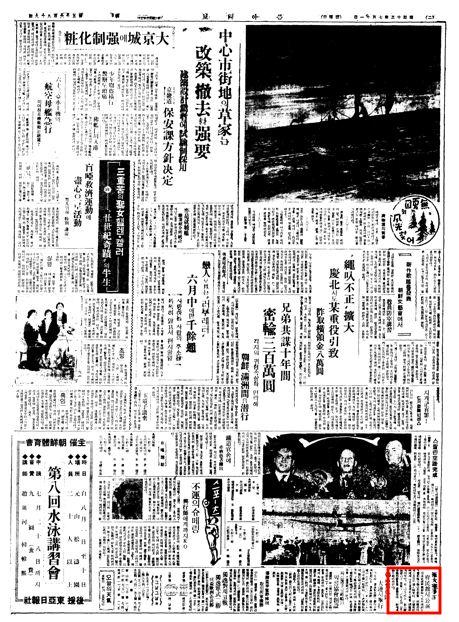
The copy of the article I could obtain from the Korean newspaper Dong-A Ilbo (Korean: 동아일보, Hanja: 東亞日報, literally East Asia Daily) dated July 11, 1937 describing this event is very bad and mostly illegible. But according to Jung/Liu/Shishida in the Journal of Martial Arts Anthropology (Vol. 15, no. 3, 2015) who dug out the article in the first place, Funakoshi in July 1937 together with 11 students of Takushoku University (拓殖大学) gave a karate demonstration in the Gyeongseong Bumingwan (京城府民館), a multi-purpose building in Seoul. According to Jung Kyungwon (2016: 78) the text reads “The Japan Butokukai Korean Regional Headquarters invited the Takudai Karate Club to hold a karate demonstration at the Gyeongseong Bumingwan. Master Funakoshi and the 11 members of the Takudai Karate Club will demonstrate the essence of karate and introduce it to the general public.”
Thanks to Aritomo Ito for sharing Jung’s study.
Update (August 21, 2025): Mario McKenna referred to the same article in a blog post dated of August 2015 that no more available to my knowledge.

 Investigations into the history of karate