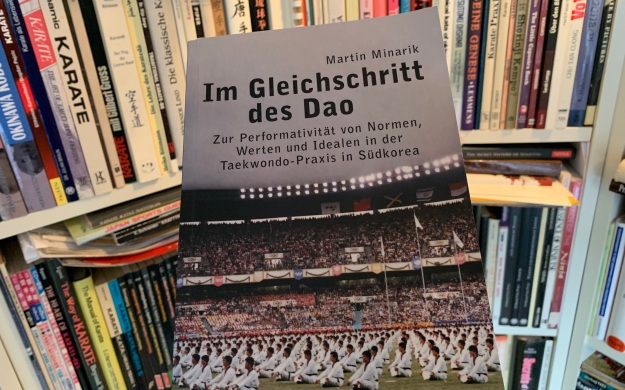
For the academic study of karate, it is also important to think outside the box. I always look to see what’s new on the market and what scholarly approach the authors have chosen for their research of other martial arts disciplines.
There is no question that norms, values and ideals play a role in Korean taekwondo 태권도 – as in other martial arts. In his book “Im Gleichschritt des Dao. Zur Performativität von Normen, Werten und Idealen in der Taekwondo-Praxis in Südkorea“ (In step with the Dao. On the performativity of norms, values and ideals in taekwondo practice in South Korea) (2022), Martin Minarik examines what these are, how they are embodied and how such processes are located in the context of social transformation processes, based on taekwondo practice in South Korea. Minarik studied theater, film and media studies, philosophy, East Asian studies and history in Bielefeld and Vienna and completed his doctorate at the Institute for Movement Studies at the University of Hamburg (Department of Culture, Media and Society). In addition to his research activities, he has been training taekwondo for many years.
Martin Minarik’s book, which is the revised version of his dissertation, is divided into seven parts. In Chapter 1, the introduction, he looks at martial arts as a field of research and gives an overview of his research questions and the structure of the work. Chapter 2 describes the institutional structure, history and spirit (as a “conglomerate of norms, values and ideals”) of taekwondo. Chapter 3 develops the theoretical basis for the empirical examination of the topic, which is followed by preliminary methodological considerations in Chapter 4.
Chapter 5 deals with a case study focusing on the training practice of taekwondo using the example of a school, in which the author takes a look at the training location (dojang, hangul 도장, hanja 道場), the participants and the training. This case study was conducted during a research stay in Seoul in 2015/6 over a total period of four months in the form of participant observation. In the sixth chapter, the author relates his “performativity-aesthetic analysis” – resulting in a “self-referential Taekwondo spirit” – to the “institutional Taekwondo spirit” he had previously elaborated. Minarik identifies a budō discourse, to which the jūdō founder Kanō Jigorō 嘉納 治五郎 (1860–1938) is also said to have contributed, as a significant influence on early taekwondo. In this context, a better recourse to the (further) historical influencing factors already well described in the second chapter would help, such as the karate of Funakoshi Gichin 船越 義珍 (1868–1957), who will have had an influence on the understanding of values in Korean taekwondo through his own discourse (detached from Kanō).
In the concluding seventh chapter, Minarik then presents his findings, which center on the realization that there is no unique taekwondo spirit. He notes that norms, values and ideals differ from case to case, sometimes in significant ways. This is simply because forms of taekwondo practice have “continuously changed in the context of social discourse and transformation processes in South Korea”, and thus also the spirit, which is subject to “temporality” and “spatiality”.
Minarik’s work makes an important contribution to the research field of martial arts studies on various theoretical levels. It is particularly recommended with regard to the academic examination of norms, values and ideals in the field of martial arts. It remains to be said: This book offers an interesting analysis of the connection between taekwondo practice and cultural values, norms and ideals. Minarik uses a wide range of sources to paint a complete picture. Overall, “In step with the Dao” is an important contribution to understanding the relationship between athletic practice and cultural values, norms and ideals. The book is well-written, well-researched, and well-organized, and it will be of interest to academic readers as well as anyone interested in taekwondo, martial arts, and cultural studies. I have no hesitation in recommending it.

 Investigations into the history of karate
Leave a Reply