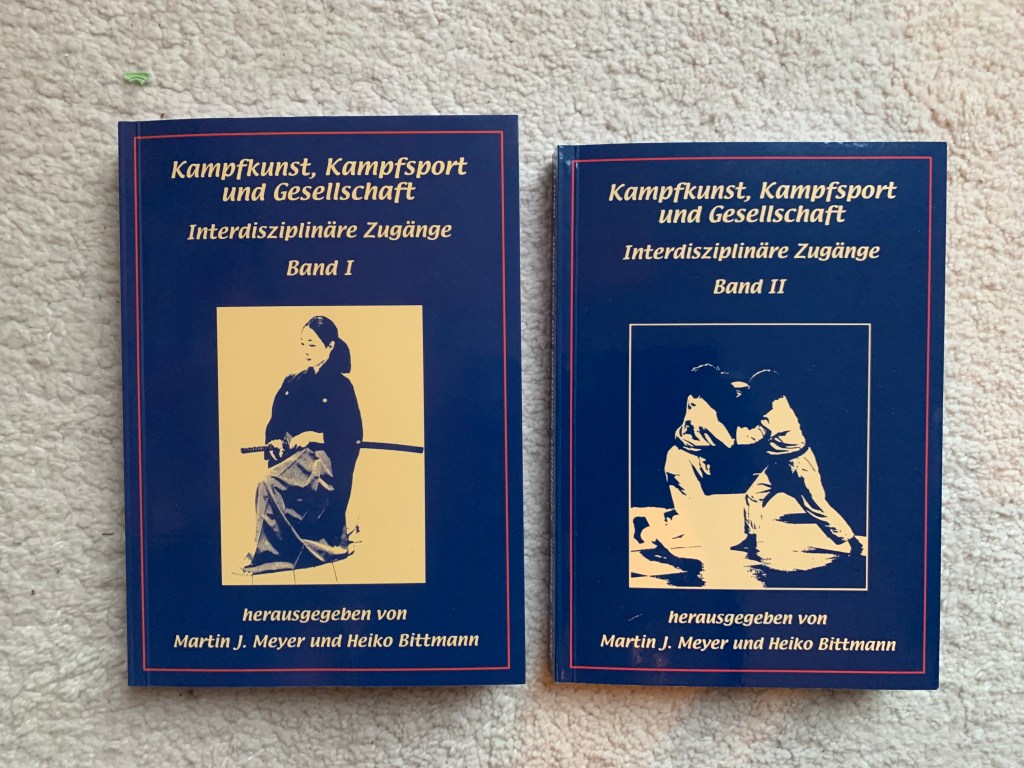
The ademic study of martial arts and combat sports is fortunately attracting growing interest. Michael Calandra, operator of the popular video podcast Martial Truth and himself a veteran master of various martial arts, even speaks of a golden age of martial arts research. A growing number of research works are now on the market. A lot is also happening in the field of anthologies. For their series ‘Kampfkunst, Kampfsport und Gesellschaft: Interdisziplinäre Zugänge’ (Martial Arts, Combat Sports and Society: Interdisciplinary Approaches), editors Martin J. Meyer and Heiko Bittmann have recruited a select number of authors who are experts in their respective fields. Their contributions cover various topics from the focus area of the anthology and are dedicated to historical, pedagogical and political phenomena of martial arts and combat sports.
Kampfkunst, Kampfsport und Gesellschaft: Interdisziplinäre Zugänge (Martial Arts, Combat Sports and Society: Interdisciplinary Approaches – Volume I) was published in 2023 with nine contributions. In addition to the editors who contributed to the book, the authors are Markus Klein, Martin Minarik, Uwe Mosebach and Henning Wittwer.
Volume II was published in 2024 with ten contributions. In addition to some of the authors from the first volume, this time the editors were able to win Rita Nemeth, Andeas Niehaus, Sigrid Happ, Natalia Gyros and Peter Kuhn as contributors.
As a result, both volumes are outstanding works that deal with the multi-layered relationships between martial arts, combat sport and society. The editors have put together an impressive collection of contributions that shed light on both academic and practical perspectives. I particularly liked the combination of tradition and modernity, which shows how martial arts and combat sports are evolving without losing their cultural roots. The two volumes are a must-read for anyone interested in the deeper meaning of martial arts and combat sports. I am already looking forward to the next volume and am excited to see what further insights and perspectives it holds!
In the end, the only thing missing from the volumes are short profiles of the authors (which are available on the publisher’s website). Furthermore, the international research community will wonder wistfully why this outstanding enrichment of academic discourse is not available in English.
For more information on Volume I click here.
For more information on Volume II click here.

 Investigations into the history of karate