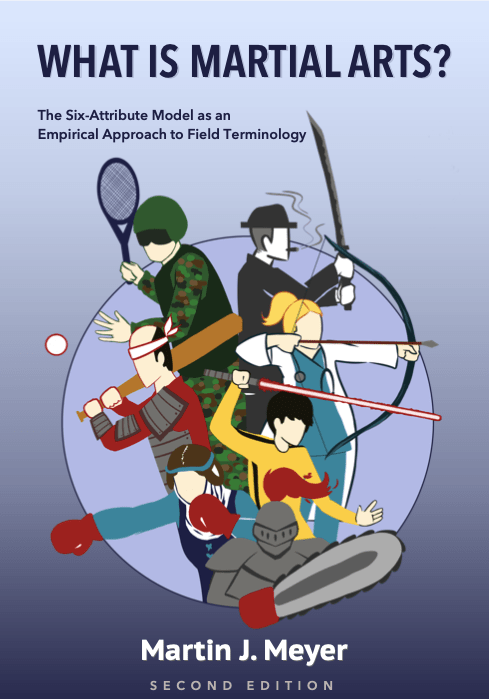
For the academic study of karate, it is also important to think outside the box. I always look to see what’s new on the market and what scholarly approach the authors have chosen for their research of other martial arts disciplines.
What defines martial arts? Various authors have already investigated this question. At first glance, the answer seems simple. But if you take a closer look at the phenomenon and consider various aspects, the answer is not exactly clear.
In his study “What is Martial Arts? The Six-Attribute Model as an Empirical Approach to Field Terminology“ (2022), Martin J. Meyer provides a rigorous and methodologically nuanced attempt to define martial arts within the academic domain. As an interdisciplinary field of study, martial arts research has long struggled with establishing a universally accepted definition due to its diverse historical, cultural, and functional manifestations. Meyer aims to address this challenge through an analytical framework designed to classify and distinguish martial arts from other forms of human movement and combat-related activities.
Martin Meyer is a martial arts scientist and lecturer at the University of Vechta. His research projects deal with interdisciplinary, in particular pedagogical, sociological and motivational aspects of martial arts as well as basic theory.
He organizes his book into three primary sections: (1) a critique of existing definitions of martial arts, (2) the methodological foundation for his proposed model, and (3) an exposition of the Six-Attribute Model itself. The first section serves as an extensive literature review, demonstrating how previous definitions—often rooted in either practical application (self-defense, sport, or warfare) or cultural significance—fail to encompass the full complexity of martial arts. By engaging with both historical sources and contemporary scholarship, Meyer highlights the limitations of reductionist definitions that either overgeneralize or exclude key aspects of martial arts practice.
In the second section, Meyer outlines his empirical approach, a bilingual video study. The use of empirical data in conjunction with theoretical insights is particularly valuable in advancing the academic study of martial arts beyond anecdotal or tradition-based accounts.
The core contribution of the book is the Six-Attribute Model, which is introduced in the final section. This model identifies six defining attributes of martial arts: (1) embodied human combat with the subproperties ‘human combat’ and ‘embodied performance’ , (2) unarmed or cold armament, (3) doctrine of a master reality with the submechanisms ‘complexity reduction’ and ‘reality drive’ , (4) fight culture identity with the subproperties ‘fight culture hegemony’ and ‘symbolic elimination’, (5) systematisation with the submechanisms ‘trial in combat
laboratory’, ‘systemic transmission’ and the (not mandatory, but likely) subproperties ‘fight principles’, ‘normative framework’ and ‘ institutional autonomy’, and (6) autoimmunity. Meyer argues that a given practice can be classified as a martial art if it possesses a significant number of these attributes. This flexible yet structured framework allows scholars to analyse martial arts in a way that accommodates historical transformations, cultural variations, and hybrid practices such as mixed martial arts (MMA) or contemporary self-defence systems.
One of the book’s most significant contributions is its methodological clarity. By adopting an interdisciplinary approach, Meyer bridges gaps between fields such as anthropology, sports science and philosophy. Moreover, his Six-Attribute Model offers a pragmatic solution to long-standing definitional disputes, providing a framework that is both empirically grounded and adaptable to different martial traditions.
In addition, Meyer’s critical engagement with previous literature strengthens his argument by systematically demonstrating why previous definitions have been inadequate.
Conclusion
“What is Martial Arts?“ is a seminal contribution to the academic study of martial arts. Meyer’s Six-Attribute Model provides a well-reasoned and methodologically sophisticated framework that advances the conceptual clarity of the field. The book is particular value to scholars interested in the field of martial arts, sports, and culture, as well as for practitioners seeking a deeper understanding of their discipline.

 Investigations into the history of karate