As early as August 1908, Kanō Jigorō 嘉納治五郎 (1860–1938), founder of the Kōdōkan, observed a group of Okinawan middle school students demonstrating karate during the Youth Bujutsu Exhibition at the Kyōto Butoku Kai. Several years later, in April 1911, he invited a small group of third-year students from the Okinawa Prefectural Normal School—then visiting Tōkyō—to perform their karate at his dōjō. In May 1922, after Funakoshi Gichin 船越義珍 (1868–1957) presented his art at the First Exhibition of Sport and Physical Education in Tōkyō, he and Gima Shinkin 儀間真謹 (1896–1989) were invited to give a demonstration before Kanō and a large audience at the Kōdōkan. Finally, in January 1927, Kanō himself traveled to Okinawa to study karate firsthand and exchange ideas with some of the island’s leading experts.
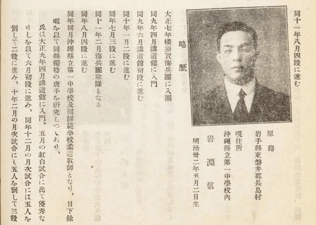
In addition to the well-known events, there exists another, lesser-known episode highlighting the early connection between jūdō and karate—presented here for the first time. While browsing a 1922 issue of the Kōdōkan publication Jūdō, I came across a reference to Iwabuchi Makoto 岩渕信 (1899–?), who had practiced both jūdō and karate in Okinawa. According to the article, in August 1922—just a few months after Funakoshi’s much-cited demonstration—Iwabuchi was appointed head of the jūdō department at both the First Middle School and the Okinawa Normal School in Shuri. In his free time, he engaged in the study of Okinawan karate.
According to Nishihama Yoshimitsu 西浜良光, chairman of the Okinawa Prefecture Jūdō Federation, Iwabuchi—together with figures such as Kimura Yoshio 木村義雄, who had been dispatched by the Kōdōkan—played a pivotal role in founding the Okinawa-ken Kōdōkan Yūdansha-kai 沖縄県講道館有段者会 following his promotion to 4th Dan in August 1922. He remained in Okinawa from that time until December 1925, serving as a commissioned instructor at the Okinawa Normal School.
Although several mainland Japanese had become acquainted with Okinawan karate since the early 20th century, Iwabuchi’s case stands out as a particularly noteworthy example of early cross-regional martial exchange. As an accomplished jūdōka with hands-on experience in karate, he represents one of the earliest documented instances of a mainland practitioner actively engaging with Okinawan martial traditions.
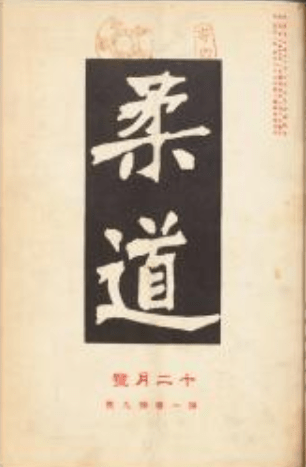
Cover of publication Jūdō
by the Kōdōkan
Unfortunately, little is known about Iwabuchi’s time in Okinawa or the extent to which he practiced karate during his stay. Fortunately, however, other stages of his life are better documented and are outlined below. According to the available records, he joined the Imperial Navy Yokosuka training unit in 1918. In April 1920, he entered the Kōdōkan, where he was awarded 1st Dan just two months later, in June. His advancement was rapid: he achieved 2nd Dan in January 1921 and 3rd Dan in July of the same year. In February 1922, he transferred to the Imperial Navy Reserves.
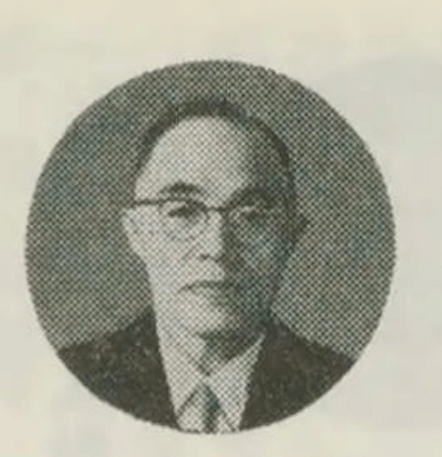
Iwabuchi Makoto, 8th Dan (1960s)
From December 1925 until the end of World War II, Iwabuchi held various positions in Taiwan, serving as an executive of the Tainan branch of the Dai Nippon Butoku Kai 大日本武徳会 and as a jūdō instructor at institutions including Tainan High School, the Normal School, and the Governor’s Office. His jūdō ranks reflect a steady rise in recognition: he was promoted to 5th Dan in 1928, 6th Dan in 1933, 7th Dan in 1939, and ultimately to 8th Dan in 1951.
Many thanks to Mr Lance Gatling (The Kanō Chronicles) for his invaluable support in the research of Iwabuchi Makoto.
Sources:
Feldmann, Thomas (2024): Yabu. The Untold Journey of an Okinawan Man. Lulu Press
Kōdōkan bunka-kai (1922): 岩渕 Iwabuchi, in: 柔道 Jūdō, 1(9), 講道館文化会 Kōdōkan bunka-kai, December, page 26
Kudō, Raisuke (ed.) (1965): 柔道名鑑 Jūdō meikan (Jūdō Handbook). Tōkyō: Jūdō meikan kankōkai, page 18
Nishihama, Yoshimitsu (2020): 今月のことば Kongetsu no kotoba (Word of the moth), Kōdōkan Jūdō Institute, December 2020

 Investigations into the history of karate