
Historical footage of karate is exceedingly rare. Nevertheless, there are indeed pre-World War II recordings that offer brief but valuable insights into karate as it existed in a particular place and time.
One such example is the American propaganda film Know Your Enemy: Japan, which was released on August 9, 1945—shortly before the war’s end—and shown exclusively to U.S. servicemen for a limited period. However, when the war ended, the film was immediately withdrawn from public circulation (Dower 1987: 18).

Within its runtime of just over an hour, the film features a few brief scenes depicting karate practitioners. These sequences were likely drawn from captured Japanese newsreels to which the American filmmakers had access. As Dutch researcher Hans Schoots notes, “they selected the visual material from hundreds of Japanese and American newsreels, fiction films and shorts” (2000: 174). Given that the film was in production from 1942 to 1945, the karate footage can tentatively be dated to the late 1930s or early 1940s. Further research would be required to identify the original sources of these scenes with greater precision.
Development of the film
After the United States entered World War II, the U.S. Army formally enlisted renowned film director and six-time Academy Award winner Frank Russell Capra (1897–1991) to produce documentary films intended both for the general public and as orientation material for soldiers before and during deployment. As film historian Claudia Springer explains, “American military propaganda was transformed during World War II when Hollywood directors went to work for the government and injected a sense of drama into documentary formats” (1986: 151).
One of these propaganda films focused specifically on Japan, with production beginning as early as 1942. However, the project was plagued from the outset by the government’s uncertainty over its foreign policy stance toward Japan. This indecision significantly delayed the film’s completion and ultimately led to its late release in 1945.
Scenes in which karate is depicted
The karate scenes in Know Your Enemy: Japan depict various settings, individuals, and techniques. This segment emphasizes martial imagery that aligns with the film’s broader objective: to portray Japan as a militant and aggressive nation with capable, disciplined soldiers. As Claudia Springer notes, “All the film’s assertions as well as its cinematic techniques are designed to instill fear and hatred of the Japanese in American viewers” (1986: 151). While karate is not explicitly identified, jūdō and jūjutsu are mentioned—likely reflecting a lack of distinction between these martial systems on the part of the filmmakers. The narration offers only minimal description of the footage. The portrayal of unarmed martial arts in this context reinforces a depiction of the Japanese as treacherous and deceptive, implying a willingness to use any tactic, including feigned defeat, to overcome their opponents.
Scene 1 [45:40]
Narrator: “To try to take the place of baseball the rulers encouraged the old Shintō approved sports like sumō, kendō, and jūdō”.
Two fighters wearing white uniforms and black belts are shown engaged in combat. The fighter on the right initiates an attack with a right oi-zuki (lunge punch), while the fighter on the left counters with a strike aimed at the attacker’s throat.
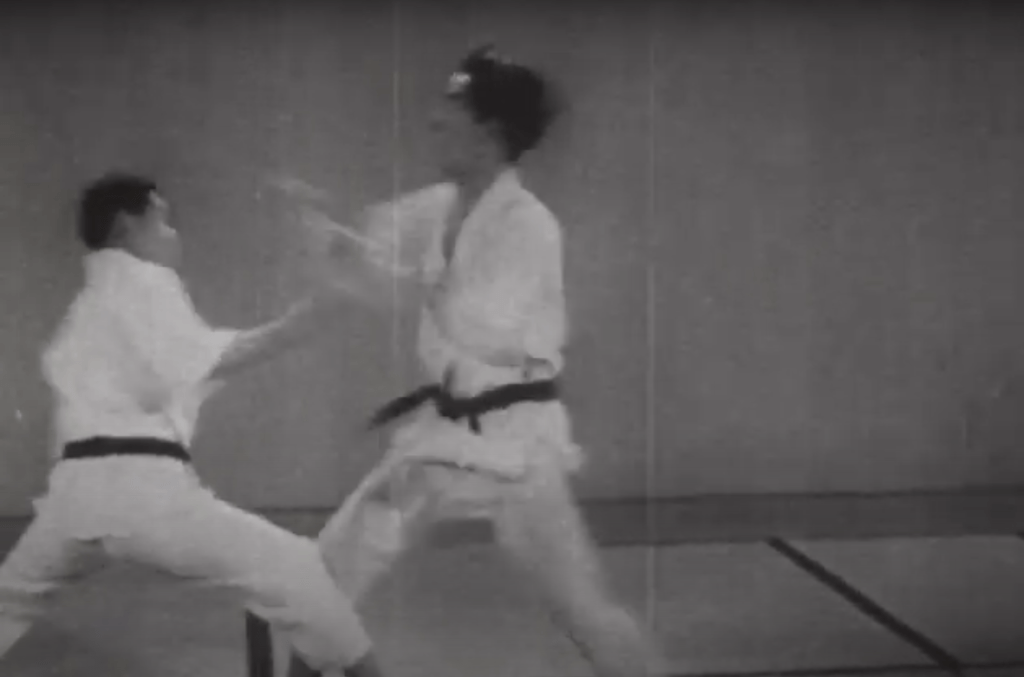
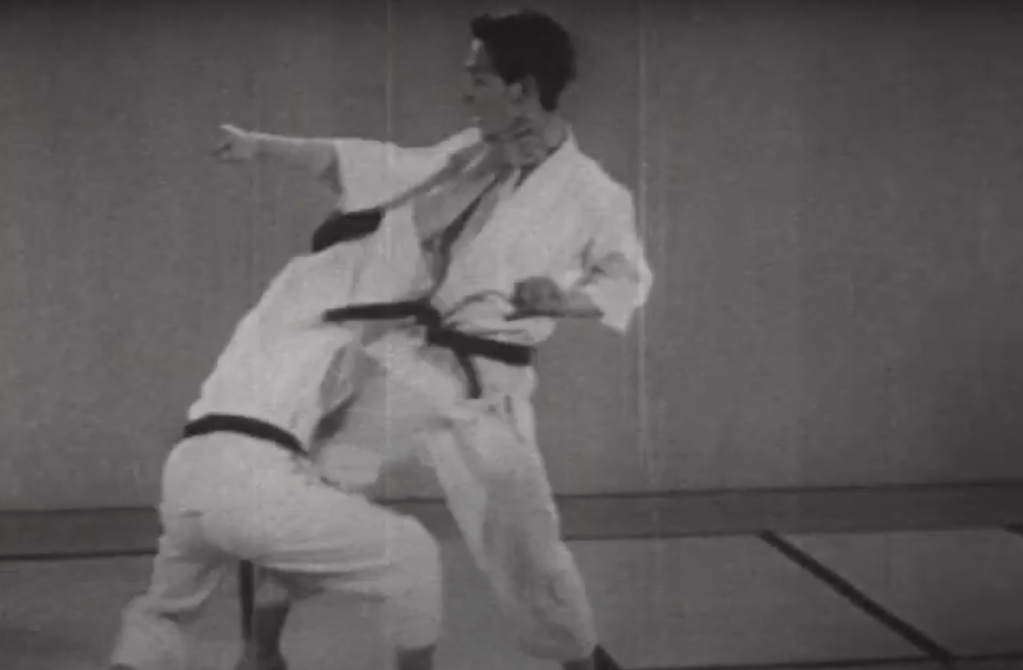
In a subsequent scene depicting jūdōka grappling, the narrator states: “Jūdō or jūjutsu is the act of giving in, making your opponent lose his balance, then tripping, choking, hitting, chopping, poking, or kicking his vital spots.”
Scene 2 [51:48]
Set to the rhythmic pounding of an industrial sledgehammer, young children are shown practicing gymnastics and martial arts, including kenjutsu and karate techniques. One scene features a group of approximately ten boys dressed in black trousers, white shirts, and white headbands, standing in a natural stance as they perform choku-zuki (straight punches) in alternating left and right motions.


The accompanying narration draws a direct parallel between physical training and ideological conditioning: “As the steel is shaped by beating and hammering, so is the boy hammered and beaten into the shape of the fanatic samurais.”
Scene 3 and 4 [52:47]
Three karateka, dressed in white uniforms with black belts, simultaneously strike a single sandbag suspended at the center of a training hall (dōjō) resembling the interior of the Shōtōkan. In the background, the same scrolls depicting deities—visible in the 1939 inauguration photograph—hang on the rear wall. This is immediately followed by a scene depicting several karateka practicing outdoors, delivering gyaku-zuki (reverse punches) and uraken-uchi (backfist strikes) to a makiwara (striking post). This courtyard too looks very similar to Shōtōkan related photographs.
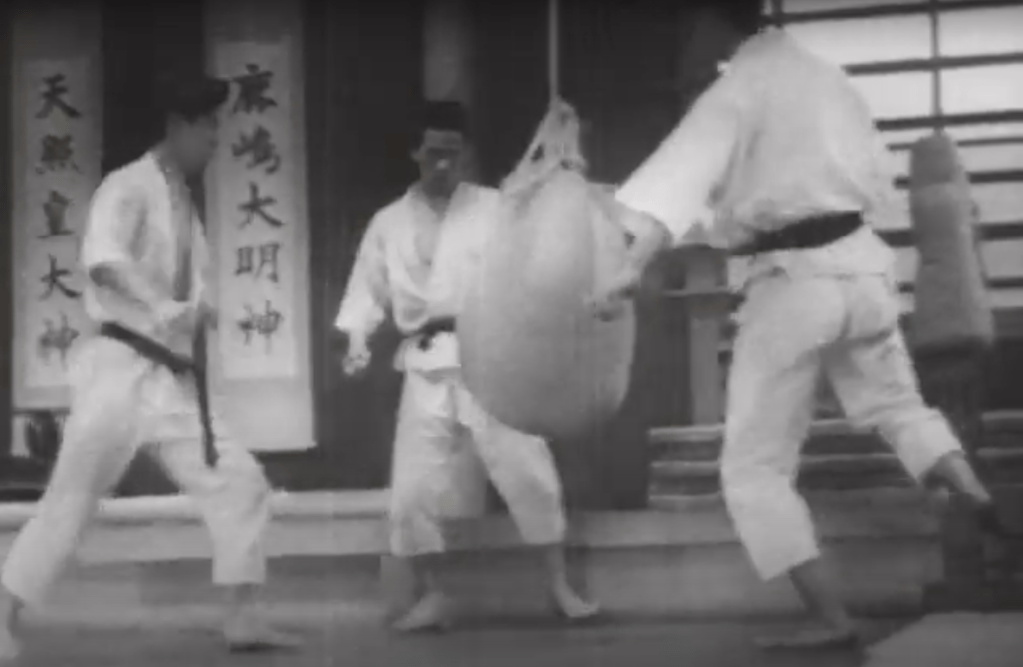
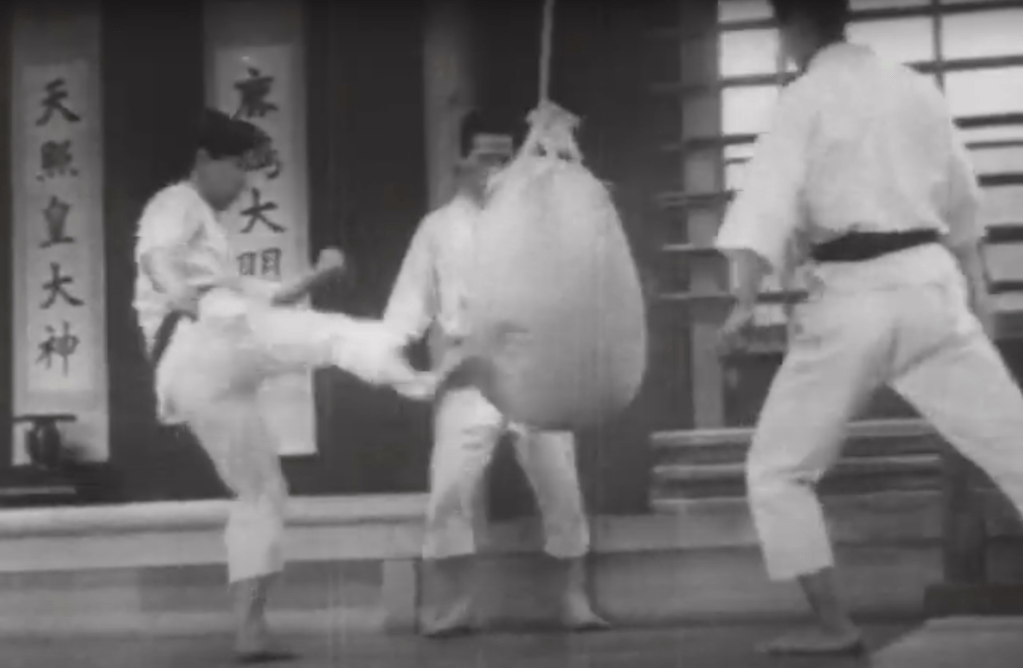
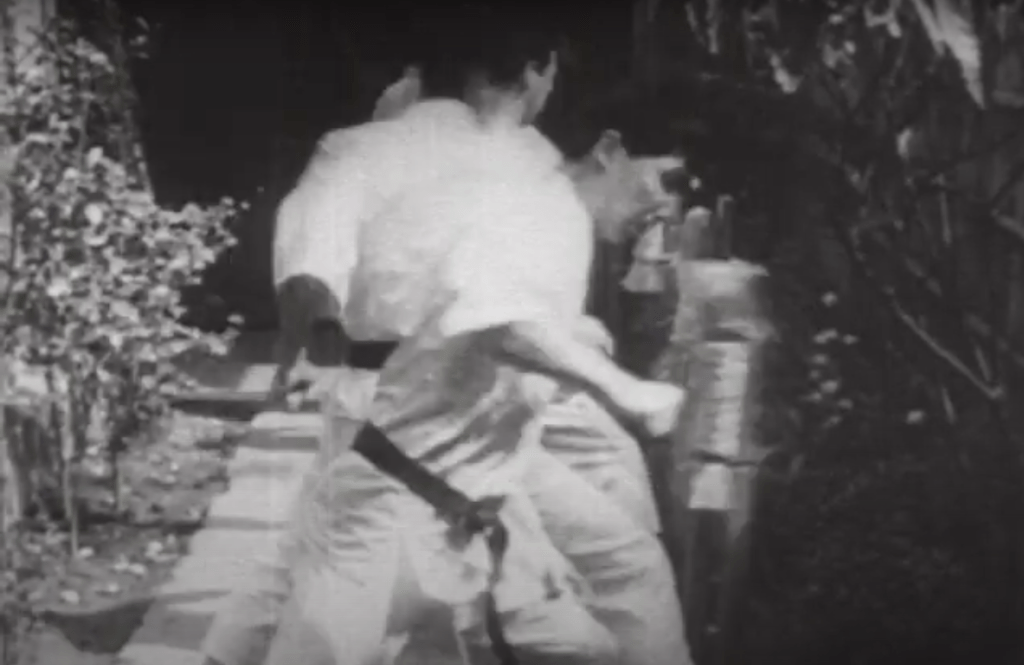
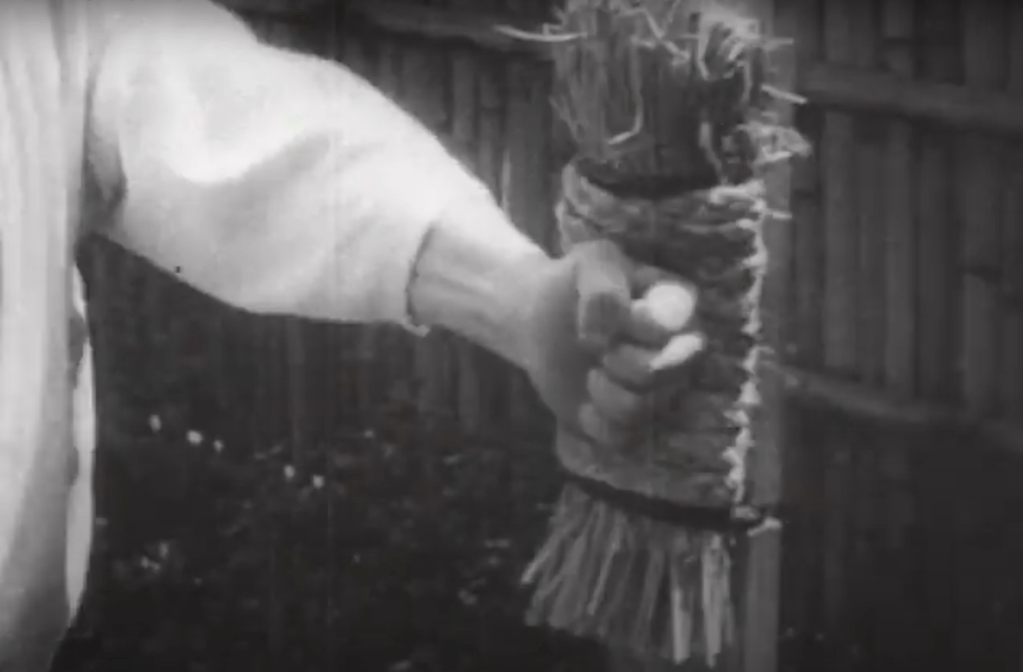
While the film has been the subject of considerable scholarly analysis, references to martial arts—particularly the brief yet vivid depictions of karate—have, to the best of my knowledge, not been examined in detail. There is only a brief reference to this in one of Graham Noble’s works. These scenes represent a rare historical artifact, offering valuable insight into prewar martial practices as captured on film.
Sources:
Dower, John W. (1987): War without Mercy: Race and Power in the Pacific War. New York: Pantheon; Illustrated Edition (19861)
Know Your Enemy Japan (1945). Director: Frank Capra. Produced by U.S. War Department
Schoots, Hans (2000): Glamour Boy of the Revolution (1941–1944), in: Living Dangerously: A Biography of Joris Ivens. Amsterdam University Press, pp. 163–178
Springer, Claudia (1986): Military Propaganda: Defense Department Films from World War II and Vietnam, in: Cultural Critique, No. 3, American Representations of Vietnam (Spring), pp. 151–167

 Investigations into the history of karate