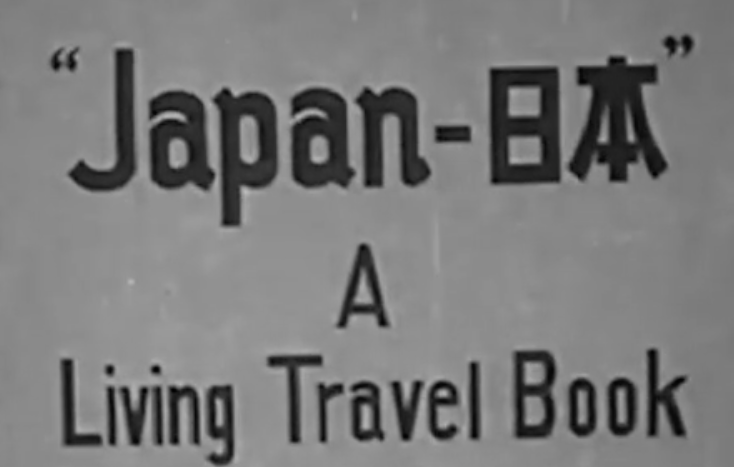
Recently, I came across the TV documentary Japan – A Living Travel Book. Sponsored by the Japan Society for International Cultural Relations, the film was likely produced in 1938 by James Farquharson Leys (1901–1999), a Canadian author, historian, and radio broadcaster.
A Living Travel Book is a documentary that portrays Japan in the late 1930s. It offers a broad perspective on the country’s social, cultural, and economic life during that period. Notably, traditional martial arts such as sumō—and even karate—are featured. At minute 6:17 of reel 5, the film shows two karateka observing protocol, wearing white karategi and black belts. They engage in a free sparring session in front of the camera, demonstrating various techniques, with seated spectators visible in the background. The scene also includes paired drills of attack and defense. This segment is barely ten seconds long and presented without sound or narration. A corresponding clip can also be found on Getty Images, where there are also various karate clips from the early post-WWII period.
In 1940, James Farquharson Leys published The Better Earth: Selected from the Broadcasts, a collection of radio talks aired between 1938 and 1940. These broadcasts were intended to foster greater understanding of Asian cultures and reduce tensions in relations with Japan. Although karate is not explicitly mentioned, Leys wrote:
The traditional sports are judo, or ju-jitsu, which is an art of self-defense that has become popular all over the world, for it is a method that gives the little fellow a chance …
While the karate footage dating from 1938/9 is brief, it remains a valuable historical artifact—one that sustains the hope that more unknown, perhaps even older, visual records of karate may yet surface.
Sources:
Archive entry, Government of Canada, Item number (ISN) 46562
Leys, James Farquharson (1940): The Better Earth Selected from Broadcasts. The Olympic Press

 Investigations into the history of karate