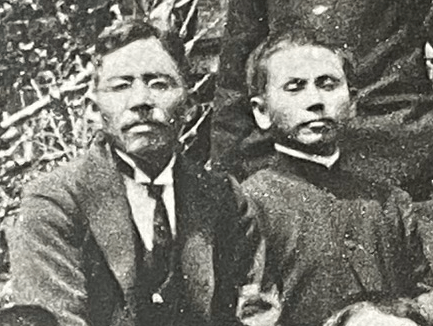
One of the key challenges in research is that one can sometimes follow the wrong path and arrive at incorrect conclusions. In karate historiography, prominent examples include the once-common theory that a weapons ban in Ryūkyū was the reason for the development of karate, and a group photo in which Itosu Ankō 糸洲安恒 (1831–1915) was believed to appear. Both claims have since been debunked.
Another persistent misconception centers around a different photograph also said to depict Itosu Ankō. Others believe the person shown is actually Kyoda Jūhatsu 許田 重発 (1887–1968). The image gained attention after Murakami Katsumi 村上勝美 published a cropped version in 1973, showing a group from Naha Elementary School 那覇小学校 which – according to him – includes (young) Funakoshi Gichin 船越義珍 (1868–1957).
I have now located the full original version of the photograph — fortunately, it includes captions. According to these, the person in question is not Itosu, but rather Higashionna Kanbun 東恩納寛文 (1872–1945), the then-principal of Naha Elementary School.


This new discovery–and given the fact that Higashionna was four years Funakoshi’s junior–also raises questions as to whether the person in the photo on his right is really Funakoshi Gichin. Higashionna did not graduate until 1893. After university in Tōkyō and after assignments on the mainland, he was employed as a teacher in Naha only after 1909 (Okinawa Kyōiku, April 1937; Okinawa Daihyakka Jiten 1983: 283–284).
Sources:
東恩納寛文氏関係写真(写) Higashionna Kanbun-shi kankei shashin (utsushi) (Photographs related to Mr. Kanbun Higashionna (copy)) (in Japanese), no date
Higaonna, Kanbun (1937): 那覇・東京・名古屋 Naha ・Tōkyō ・Nagoya, in: Okinawa Kyōiku, April, pp. 58–62 (in Japanese)
Murakami, Katsumi (1973): 空手道と琉球古武道 Karatedō to Ryūkyū Kobudō (Karatedō to Ryūkyū Kobudō). Tōkyō: Seibidō Shuppan (in Japanese)
Okinawa Daihyakka Jiten Kankō Jimukyoku (1983): 沖繩大百科事典 Okinawa daihyakka jiten (Okinawa encyclopedia). Naha: Okinawa Taimasu-sha (in Japanese)
Further reading:

 Investigations into the history of karate