
Handwritten historical sources on karate are exceedingly rare. Whenever one surfaces, it electrifies the karate world—especially the small circle of karate historians. One need only recall the unique book by Kyan Chōtoku (1870–1945), discovered some time ago, translated by Patrick McCarthy, and later made accessible as part of an anthology on the master in 2023.
Despite decades of effort by many researchers to unearth such hidden treasures, the results have remained meager. Much has unfortunately been lost over the years. All the more reason, then, for my excitement when my friend Silvio Marche recently drew my attention to a handwritten manuscript from 1936 that had been offered online in June 2021. He asked for my help in learning more about it. Regrettably, he had not purchased it at the time, and it eventually disappeared from circulation.
At first, one is naturally skeptical about such finds—whether they are genuine or not. Yet, initial investigations turned out to be rather promising.
The manuscript bears the title 琉球拳法空手術の話 呼吸を整ふ可き話 Ryūkyū Kenpō Karate-jutsu no Hanashi: Kokyū o totonofu beki hanashi (Talks on Ryūkyū Karate Techniques: On Regulating the Breath) and was published in July 1936 (Shōwa 11). The author’s name appears as Kōra (or Takara) Akihiro 高良昭廣, and the presumed publisher was an organization called Yamato Damashii Kai (大和魂會, Society for the Japanese Spirit). With its 350 pages, the work is quite extensive. According to the seller—reportedly based in Niigata Prefecture—it was “a rare and valuable document that’s hard to come by.” The condition, however, was described as poor with cut sections, water stains, red-pencil markings, handwritten notes, repair patches, yellowing and dirt. Pages 211–212, 249–262, and 277–304 were entirely missing. Fortunately, the seller had uploaded several pages online, providing a valuable glimpse into this remarkable publication.
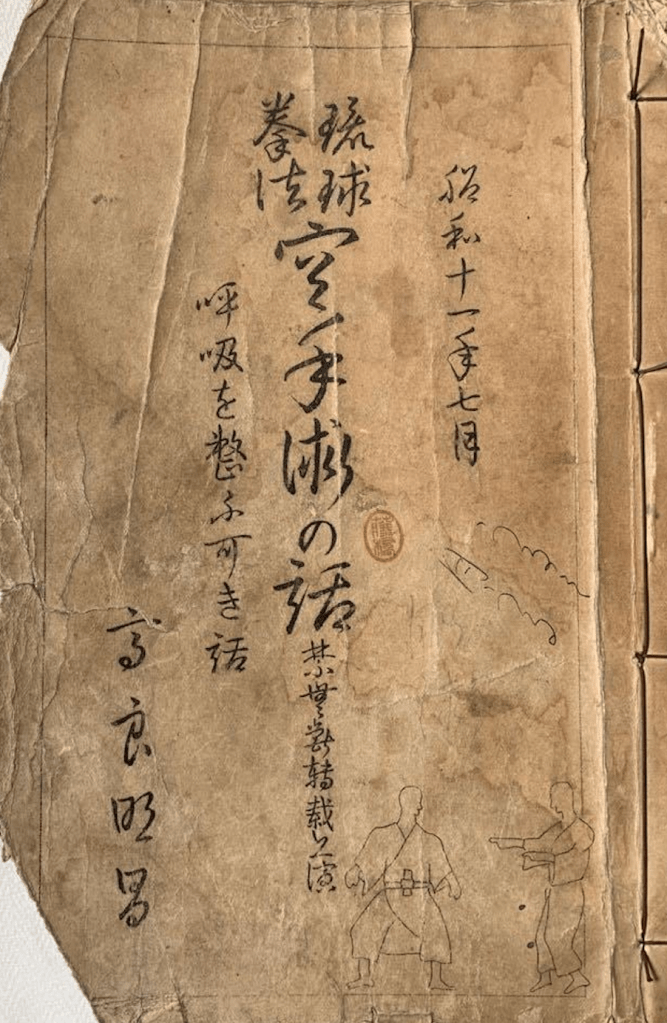
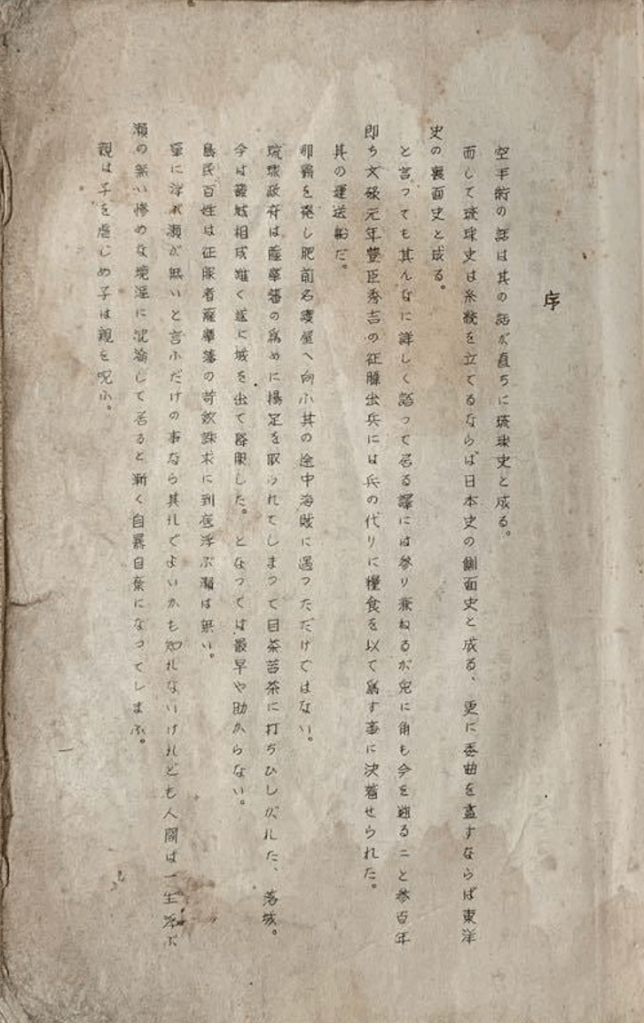

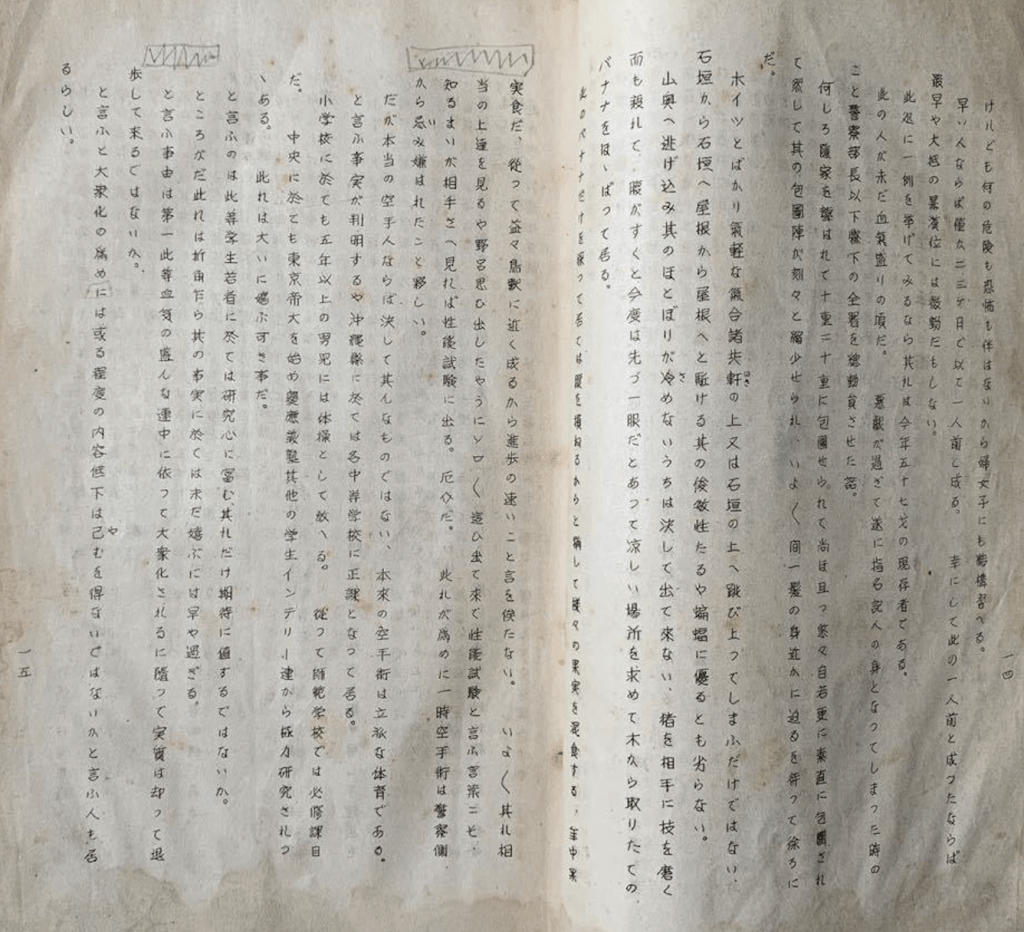

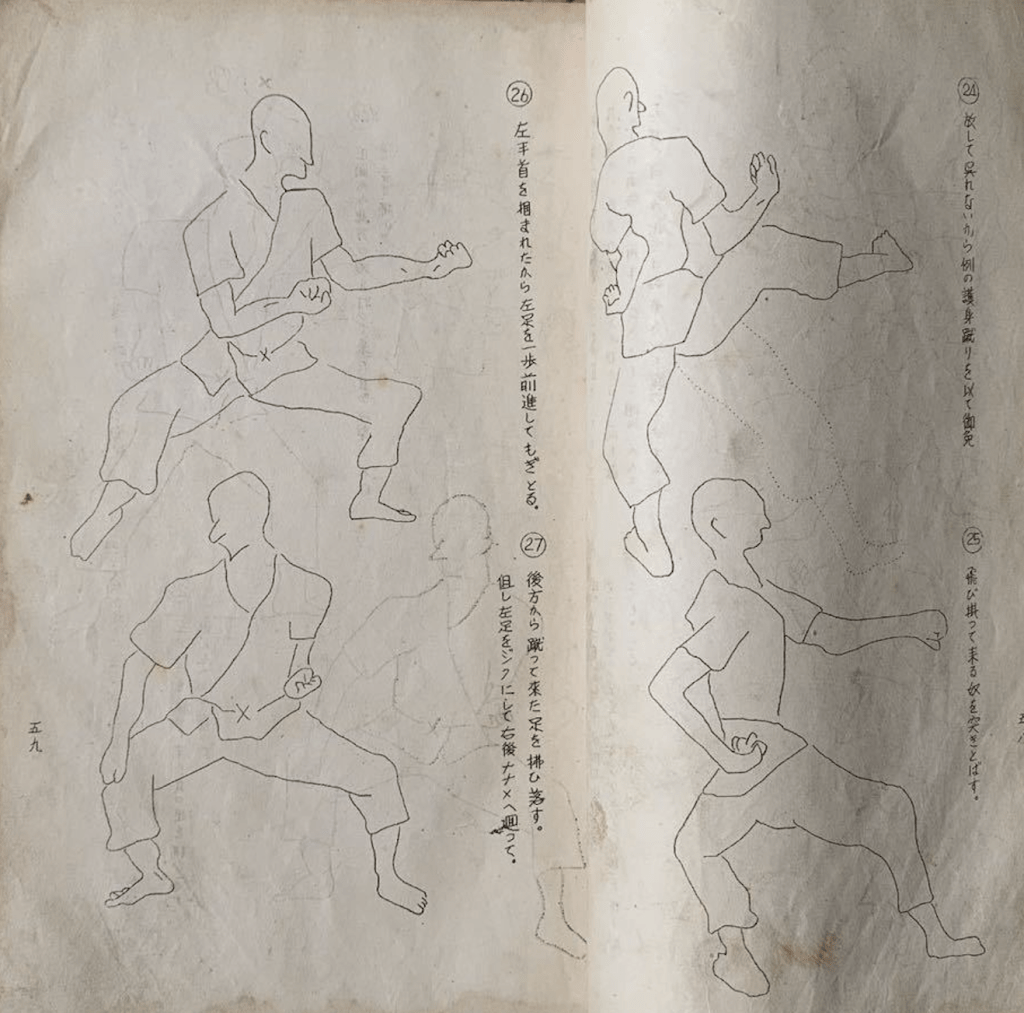
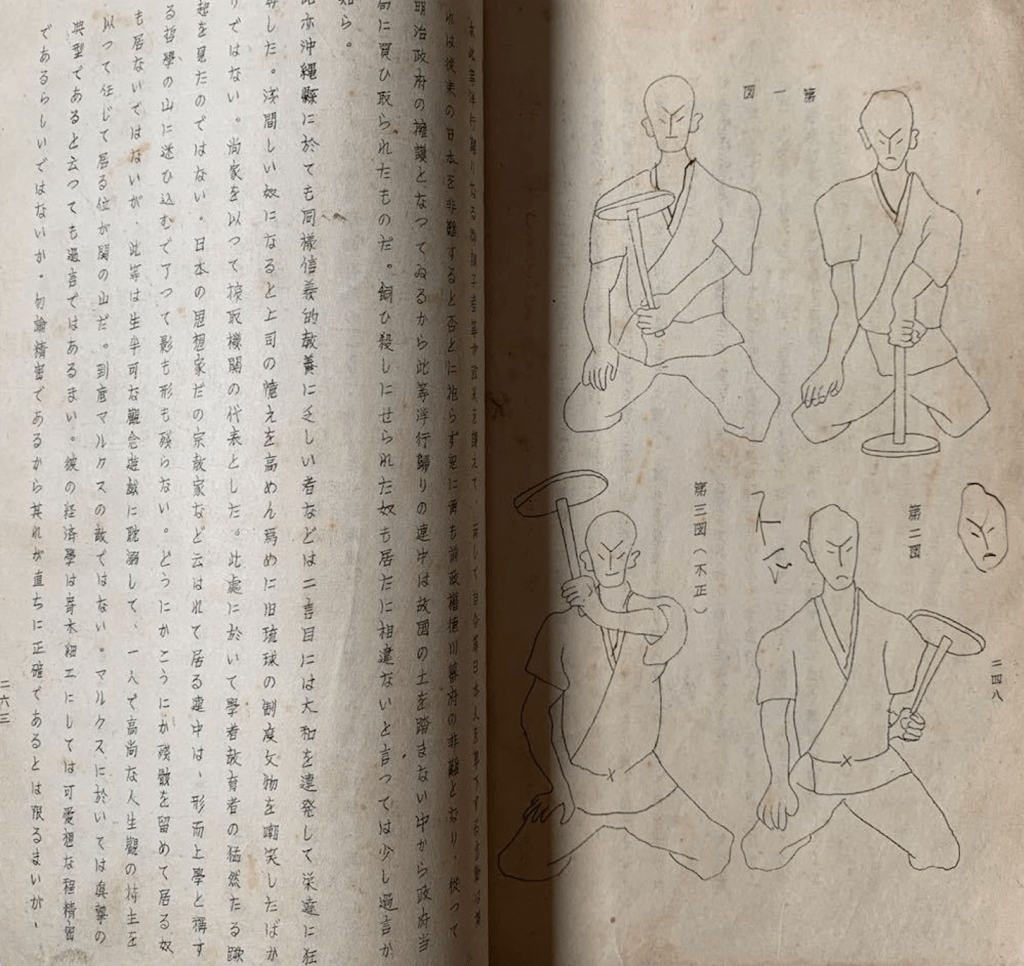

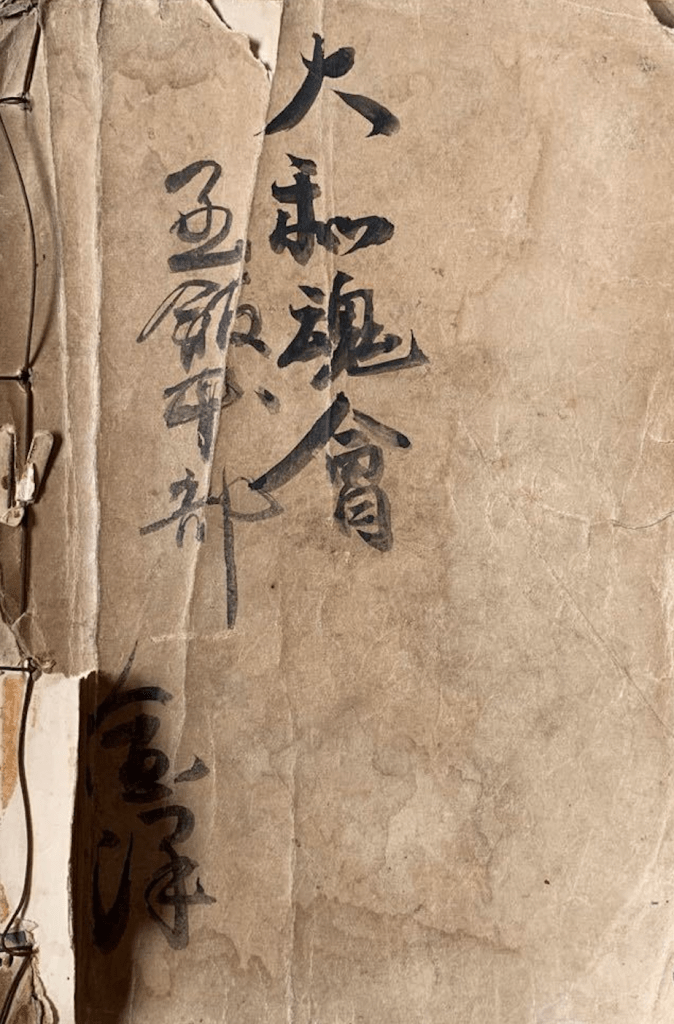
Excerpts from the 1936 manuscript (Aucview.com)
A Google search yielded little information about the manuscript, but according to the catalog of the National Diet Library, it was referenced in two publications: 武道学研究 Budōgaku Kenkyū (Journal of Budō Studies) (1979: 27) and 日本古書通信 Nihon Kosho Tsūshin (Japanese Antiquarian Books Newsletter) (1981: 30). In both cases, the author’s name is listed as Kōra (or Takara) Akihiro 高良昭広. The book also appears in Kawamoto Masayuki’s Karate Publication Catalog (1984: 2), under the title 琉球拳法空手術の研究 Ryūkyū kenpō karatejutsu no kenkyū (Research into the art of Ryūkyū kenpō karate).
Further research revealed that the Okinawa Prefectural Library appears to hold a complete copy of the work. It was very likely donated by Kinjō Hiroshi (1919–2013), as mentioned by Kadekaru et al. (2005: 213). In that context, the author’s name is rendered slightly differently as Kōra (or Takara) Akimasa 高良昭昌. The Okinawa Prefectural Library luckily gives the complete table of contents of the document from which one can gain an impression of its remarkable depth and scope.
1. Sincerity
2. Empty-Handed Techniques
3. Origin of Empty-Handed Techniques
4. Practice and Its Sequence
5. Practice with Makiwara
6. Striking Methods with Makiwara
7. Making Makiwara
8. Forms and Kicking Techniques
9. Heian Shodan (actually Pin’an Shodan)
10. Punching and Kicking Techniques for Heian Shodan
11. Merits of Heian Shodan
12. Practice Location and Time
13. Diet, Stomach, Hips, Women
14. Schools (Ryū)
15. History
16. Ryūkyū and Its Talented Individuals
17. The Ryūkyū Kingdom, Satsuma Domain, and the Shogunate
18. The Shimazu Clan, the Ryūkyū King, and the Shogunate
19. Origin of the Royal Crest of the Shō Dynasty
20. The Unadulterated Reality of Ryūkyū
21. The Greatest Turmoil in Ryūkyū’s History Since Its Founding
22. The Abolition of the Domains and the Establishment of Prefectures, and Their Fate
23. The War of 1894–95 and Okinawan Men
24. The Arrival of Foreign Ships and Captain Kanna
25. The Head
26. Temperament
27. Intuition
28. Physiognomy and Nameology
29. Learning Fortune-Telling from the Heart
30. People Who Fall into Adversity
31. The Wrist
32. Chi-shi
33. Race and Marriage
34. Ryūkyū Horses and Virgins
35. Japanese and Foreign Cultures
36. Exercise and Walking Style
37. Destiny and Character
38. High-Class Beggars and Salaried Thieves
39. The Influence of Blood
40. Karatedō
41. Testicles and Character/Emotions
42. Women’s Exercise and Ovaries
43. Women’s Magazine Self-Defense and Palm Reading
44. Chest and Gastric Ptosis
45. Naihanchi
46. Secrets of Training and Its Subtleties
47. Chijuri
48. Message to People of Color
During my research for this article, Patrick McCarthy told me that he had received a copy of the manuscript from Kinjō Hiroshi some 35 years ago. He kindly shared an image of it with me. After a comparative analysis of the two cover pages, it appears that the book was indeed printed from a handwritten original, as the two look strikingly similar.
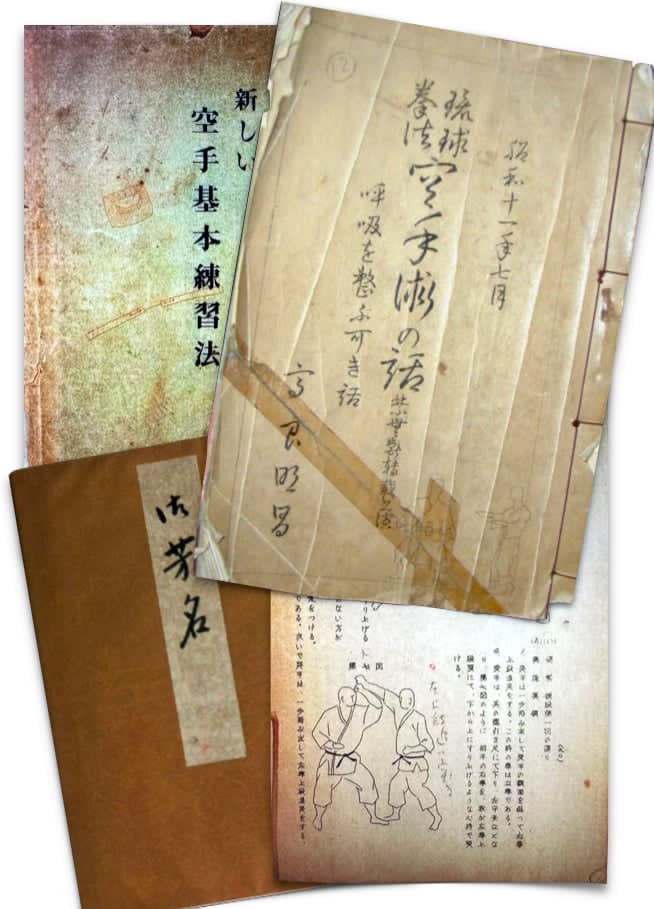
The copy from Kinjō Hiroshi, together with other stuff
(Courtesy of Patrick McCarthy)
A truly interesting topic and certainly a publication that is worth taking a closer look at.
Update – 5 November 2025:
My friend Rich Hornberger visited the Okinawan Prefectural Library and was able to confirm that the copy preserved there is the complete version from the collection of Kinjō Hiroshi. Many thanks, Rich!
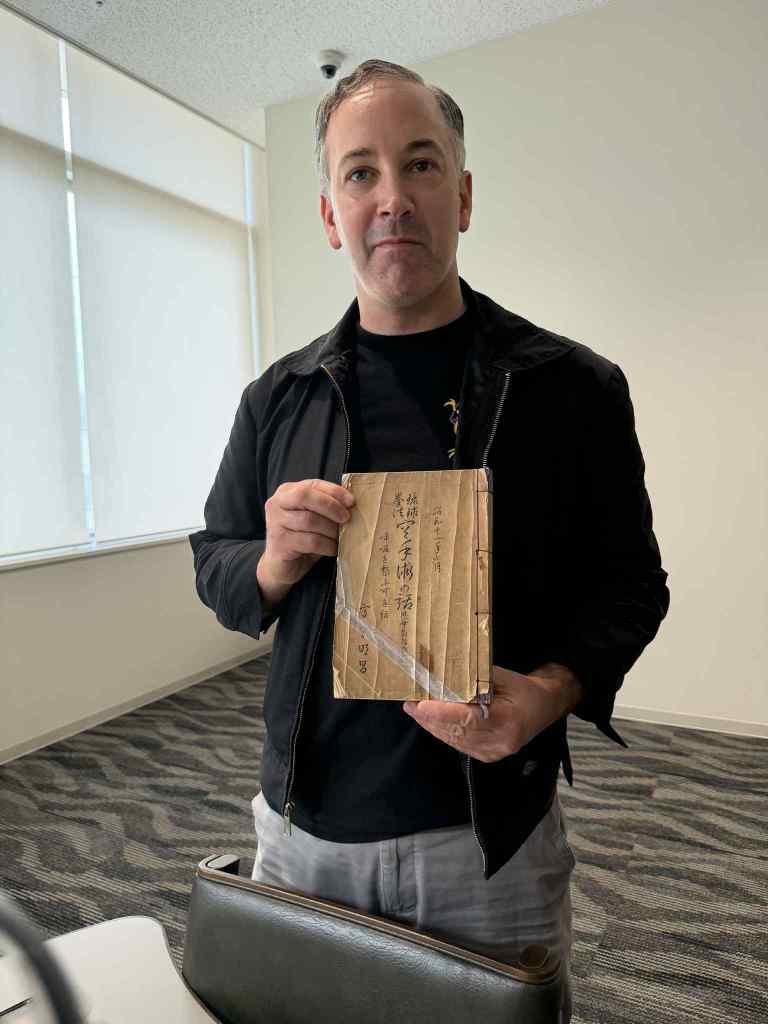
Rich Hornberger with Kinjō Hiroshi’s copy (November 2025)
Update – 14 November 2025
In my files I happened to come across a reference to this book that provides a little more information about its background. Takeishi (1999: 11–12) noted that the true identity of the manuscript remains unknown to this day. Produced in kiku 菊判 format (A4), stencil-printed, and bound in the traditional Japanese style, it is considered one of the rarest karate publications. Nothing is known about the author, and there are no indications elsewhere that he was ever active as a karate practitioner. Even an imprint is missing. Citing the text itself, Takeishi deduces the author’s background: “On 19 June 1936, at 3:45 p.m., I sit quietly in a room of a residence at 74 Horikawa-chō, Hakodate City, Hokkaidō, and lay down my brush.” Judging from the content, Takeishi concludes that although the author appears to have studied karate, he also seems to have engaged in a profession resembling that of a fortune-teller or divination specialist. Takeshi continues: “The first part deals exclusively with karate, but in the second part the book turns to the history of Ryūkyū, then discusses the utility of sexuality, and ultimately even arrives at a doctrine of the superiority of people of color over white people—the author allows himself to make virtually any claim he wishes. In this sense, it is a strange, indeed rather curious book.”
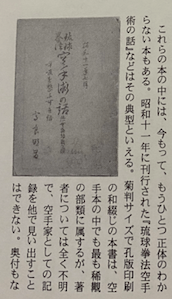
Photo of the manuscript owned by Takeishi Kazumi (1999)
Apart from the copy held by his publishing house, only one other copy has been confirmed, in the private collection of Kinjō Hiroshi. We can therefore say that at least three of these works have been preserved, two of them in their entirety.
Acknowledgments: I would like to thank Silvio Marche for bringing this to my attention and for providing additional valuable information. I would also like to thank Joe Swift, Patrick McCarthy and Rich Hornberger for their support.
Sources:
武道学研究 Budōgaku Kenkyū (Journal of Budō Studies), Vol. 11, No. 3, March 1979
Kadekaru Tōru / Ikehara Hitomi / Shinzato Aya (2005): 金城裕氏所蔵空手・武道等関係史料について Kinjō Hiroshi shozō karate budō-tō kankei shiryō ni tsuite (Printed sources and other historical materials on karate and various arts, owned by Kinjō Hiroshi), in: 史料編集室紀要 第30号 Shiryō henshū-shitsu kiyō dai 30-gō (Bulletin of the Historiographical Office, No. 30, Okinawa Prefectural Board of Education), pp. 175–190
Kawamoto Masayuki (1984): 空手道出版目録 Karate-dō Shuppan Mokuroku (Karate Publication Catalog), July
日本古書通信 Nihon Kosho Tsūshin (Japanese Antiquarian Books Newsletter), Vol. 46, No. 12 (Issue 629), December 1981
Takeishi Kazumi 武石和実 (1999): 戦前期の空手本 Senzenki no karate hon (Karate books from the prewar period), in: Gajumaru Tsūshin, No. 21 (14 May 1999), pp. 9–12 (in Japanese)

 Investigations into the history of karate