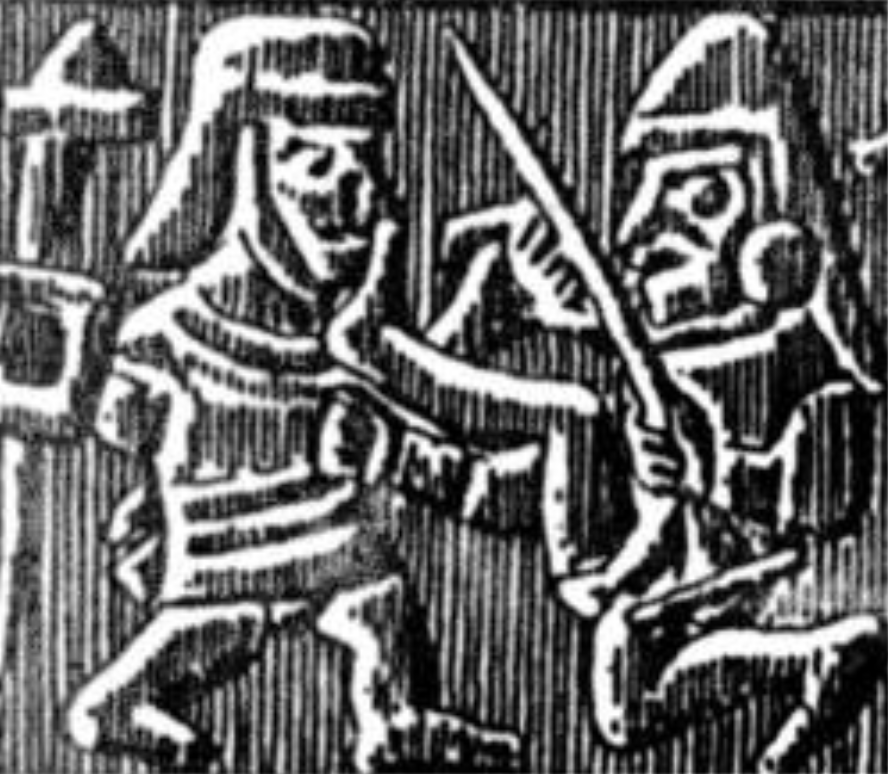
In 2005, I wrote a short piece on martial arts in pre-Columbian South America. It was written in response to a discovery by Agustín Seguí (1949–2023), who taught at Saarland University and headed the Spanish Department at the Institute of Applied Linguistics there. In 2003, he was the first to publish on what he described as Moche martial arts.
The Moche culture—named after the Río Moche and also known as Mochica—flourished between the 1st and 8th centuries on the northern coast of present-day Peru. Like its successor, the Chimú culture, its center was located in the region around the modern city of Trujillo. The Moche engaged in numerous wars, often characterized by ritualized forms of combat. Archaeological evidence includes warrior burials and depictions of warfare made from silver-plated copper.
Widespread media coverage in Germany
In July 2024, Seguí referred to his findings in Campus Magazine, his university’s publication, titled Karate in Ancient Peru. Accompanying press coverage in Germany used the discovery as an opportunity to report on it widely, with headlines such as Taekwondo in Peru (GEO Magazine, October 2004), Kung-Fu in Peru? (National Geographic Germany, January 2005). This topic was also picked up by local German newspapers. Even though the historical connection was, of course, somewhat constructed, these titles were clearly meant to attract readers’ attention.
My own short commentary in DDK-Magazin (September 2005), monthly publication of the German Dan Association, tried to provide a bit more context by drawing on additional sources. In retrospect, however, this was only partially successful, as my knowledge of the region and its historical background is quite limited. Moreover, while reviewing the sources I made an error that I would like to correct here in the course of this brief reassessment and appreciation of Seguí’s contributions.
Seguí’s research contribution
In the Journal of Latin American Lore (2003), Seguí published his findings in Spanish under the title Artes marciales mochicas (Moche martial arts). The scenes he examined are extremely rare. He searched through both the scholarly literature and museum collections, yet the find itself appears to be unique and had hardly attracted the attention of archaeologists before.
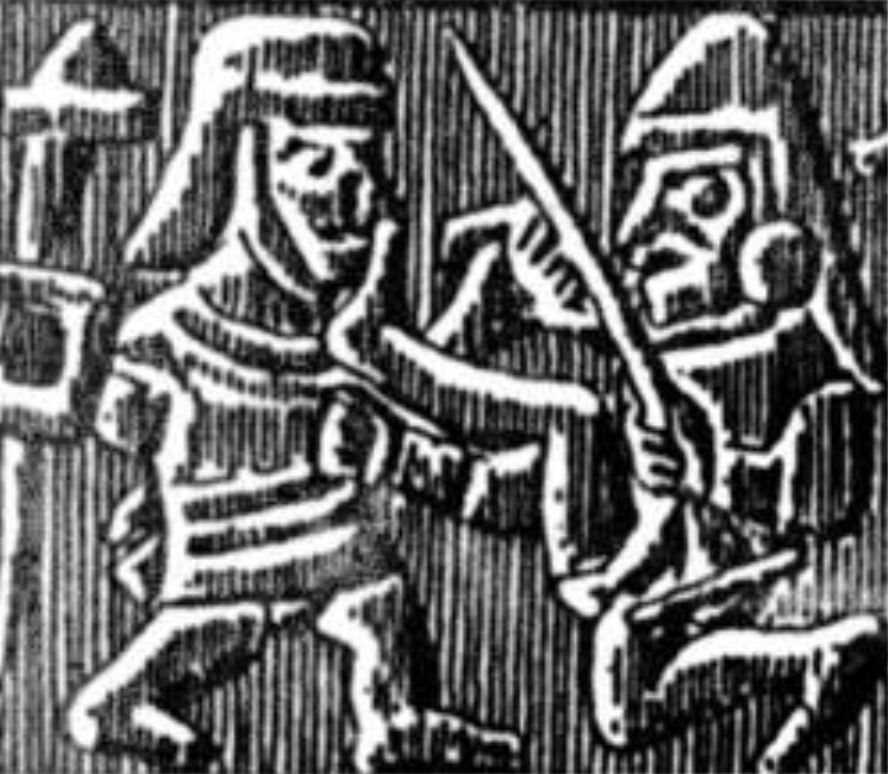
A ceramic vessel from the Moche culture in the Ethnological Museum in Berlin depicts a series of combat scenes between two warriors. The techniques shown appear comparable to those known from East Asian martial arts. Seguí therefore suggested that the indigenous peoples of South America employed combat techniques that resemble forms previously associated mainly with East Asia. To support his thesis, he assembled numerous visual depictions that had long been known in South American studies but had never been examined from the perspective of martial arts techniques and interpreted accordingly.
Source: Kutscher (1954)
For example, a ceramic cup from the pre-Inca Mochica culture—today held by the Berlin State Museums—appears to show a kick striking an opponent’s chin (see Kutscher 1954). Illustrations reproduced in Kutscher’s 1950 study Chimú: Eine altindianische Hochkultur (Chimú: An Ancient American Civilization) likewise display hand formations that bear an intriguing resemblance to certain karate fist techniques, such as the one-finger fist (nakadaka-ken) and the single-knuckle fist (ippon-ken), said Seguí.
In 2008, he presented his work in English in the article A Pre-Columbian Martial Art. He concludes:
- Mochica combat combined punches, kicks, and weapons.
2. Varied striking forms point to a structured system.
3. Notable parallels exist with East Asian striking arts.
4. Atypical fists also appear in sexual and religious contexts.
5. Combat–healing–ritual links are cross-culturally attested.
5. Their primary function was likely martial.
6. This challenges current models of martial arts diffusion.
7. A transpacific transfer may explain these parallels. (Seguí 2008:10)
Seguí’s discovery represents an interesting and potentially important contribution both to research on early human settlement history and to the study of combat cultures. At first glance, these objects might seem to provide early evidence of a combat system in pre-Columbian South America.
Seguí’s lecture
Agustín Seguí also presented his findings publicly at the International Transcultura Conference “Playing by the Rules of the Game – Jouer selon les règles du jeu,” which took place from 10 to 14 July 2006 in Merzig, Germany. On Friday, 14 July 2006, he delivered a talk titled Karate in Ancient Peru. In this presentation he outlined his interpretation of combat scenes depicted on Moche ceramics and discussed their possible relation to structured fighting techniques.
Sources for research on pre-Columbian martial arts in America
In 2005, I wrote that the martial arts researcher and author Robert W. Smith—who sometimes published under the pseudonym John F. Gilbey—visited the South American Xavante tribe in the Amazon rainforest during the 1960s. This hunting people of the western highlands, belonging to the Gê language family, practiced a distinctive form of wrestling. In 1974 [1963], he described it as follows: “Panmo” is practiced standing up, has almost no rules, and there is no clearly defined fighting area. The aim is to bring the opponent to the ground using throws, punches, and kicks. Injuries are common. Panmo fighters are brutal and extremely well trained. What I overlooked at the time was that this book was a fictional work that playfully parodies a range of martial arts stories.
However, forms of archaic and systematized combat can be found in nearly every corner of the world. For South America, for example, Van Mele/Renson (1996: 98), in their typology of traditional sports in South America, list boxing and wrestling forms for the Caribbean region, Amazonia, eastern Brazil, the Pampas, Patagonia and Tierra del Fuego, as well as the Andean region. When considering pre-Columbian forms, however, it is necessary to exclude practices that arrived in South America from Africa after the colonization of the continent. Among these is capoeira, perhaps the most prominent example.
Another relevant work certainly is Art and Moche Martial Arts by Jeffrey Quilter (2008), which also discusses representations of combat in Moche art. Unfortunately, I was not able to access this study at the time.
Conclusion
It is clear that such archaic forms of combat can hardly be compared with the systematic martial arts of Southeast and East Asia, since the codification of many of those systems largely took place only in the twentieth century. Nevertheless, Seguí’s discovery was remarkable for its time, even though, to my knowledge, it has unfortunately not yet led to more in-depth follow-up research. Given that the argument rests on only a few pieces of visual evidence, further investigation will likely remain difficult.
In fact, throughout history people in every region of the world have used whatever means were available to them in order to prevail in combat situations. A kick to an opponent’s face, however, is something that could realistically only be executed if it had been practiced beforehand, as Seguí noted. For an untrained person this is a rather complex movement and difficult to perform without preparation. Muscles and tendons must be conditioned for such a motion.
Ultimately, a single kick does not automatically mean that the technique must be derived from an Asian kicking system. For outside observers, however, such a comparison is often the most obvious and intuitive one to make. This perspective helps explain the tone of the press reports mentioned earlier.
In closing, Seguí’s efforts deserve recognition once again. One may hope that his observations will inspire further research in the future.
Sources:
Feldmann, Thomas (2005): Kampfkulturen in Südamerika (Combat Cultures in South America), in: DDK-Magazin, No. 30 (September), p. 18 (in German)
GEO-Magazin (2004): Taekwondo in Peru, in: GEO-Magazin 10/2004 (in Germany)
Gilbey, John F. (1974) [1963]: The Chavante Armlock, in: Secret Fighting Arts of the World. London, Sydney: Pan Books Ltd., pp. 88–93
Kutscher, Gerdt (1950): Chimú. Eine altindianische Hochkultur (Chimú. An ancient Native American civilization). Berlin: Gebr. Mann (in German)
Kutscher, Gerdt (1983) [1954]: Nordperuanische Keramik (Northern Peruvian Pottery). München: Verlag C. H. Beck (in German)
Mele, Veerle Van / Roland Renson (1996): Traditional Games in South America and Their Geographical Distribution, in: Pfister, Gertrud et al. (Hg.): Spiele im Spannungsfeld von Tradition und Moderne. Berlin: Academia Verlag, pp. 95–102
National Geographic, 1/2005, “Kung-Fu in Peru”, page 14 (in German)
Segui, Agustin (2003): Artes marcial Moches (Moches Martial Arts), in: Journal of Latin American Lore, 21:2, pp. 239–257 (in Spanish)
Seguí, Agustín (2005): Puños atípicos moches y manos orantes incas (Unusual Mocha fists and Inca praying hands), in: Xama 15-18, pp. 315-321 (in Spanish)
Further reading
Quilter, Jeffrey (2008): Art and Moche Martial Arts, in: Bourget, Steve ( Kimberly L. Jones (eds.): The Art and Archaeology of the Moche, University of Texas Press, pp. 215–228
Warfare. Pre-Columbian South America, 10 October 2025
Zorn, E. (2002): Dangerous Encounters: Ritual Battles in Andean Bolivia, in: D. Jones (Ed.): Combat Ritual and Performance: Anthropology of the Martial Arts. Westport, CT: Praeger, pp. 119–152

 Investigations into the history of karate