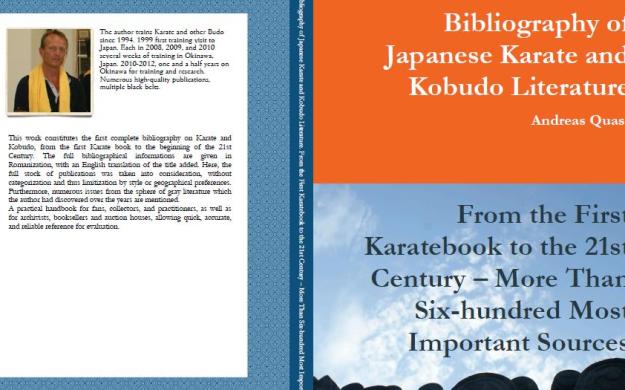
The academic study of the Japanese martial arts has only gained momentum in recent decades. An important component of research is the use of original sources. Even in the age of the Internet and online OPACs, a bibliography is an essential tool for researching sources. For the martial arts disciplines of karate and kobudō, Andreas Quast has published the first comprehensive bibliography, titled Bibliography of Japanese Karate and Kobudo Literature. From the First Karatebook to the 21st Century – More Than Six-hundred Most Important Sources (2013). The bibliography appears to be a comprehensively expanded version of Quast’s 2005 work The Confused Adept: Sources on Ryukyu Kobudo.
As the title suggests, the work comprises more than 600 entries – arranged both alphabetically (pp. 1–90) and chronologically (pp. 91–180). As befits a professional bibliography, all relevant sources are listed for each entry. For the original Japanese titles, Quast provides both the transcription of the Japanese script into the Latin script based on the Hepburn system as well as English-language translations.
In addition to works on karate and kobudō, the bibliography also lists titles which, although they contain the Japanese characters “kara” and “te”, do not refer to the art originating from Okinawa, but describe Japanese forms of self-defense (e.g. Buyōken Kensai: “SOKUZA KATSUYŌ MUTE GOSHINJUTSU”, Tōkyō, 1917). Ryūkyūan researcher Sakamaki Shunzō (1906–1973) had already mistakenly assigned this title to karate in his 1963 bibliography “Ryukyu: A Bibliographic Guide to Okinawan Studies” (see also Graham Noble: “The First Karate Books”, 1995). However, this in no way detracts from Quast’s work, as such contemporary works complete a bibliography on karate and kobudō in an excellent way and complement the overall picture of the extensive subject area.
Conclusion: Quast’s bibliography is an extremely important contribution both for the interested adept who is concerned with Japanese karate and kobudō and for the scientifically interested person who is doing research on karate. The book should not be missing from any specialist Japanese library. The only drawback is the fact that the bibliography lacks an introductory text. It is to be hoped that in a new revised edition, Quast will share his experience in researching Japanese-language titles and their translation with the reader in an introductory chapter, in addition to correcting a few minor typographical errors (e.g. “Bukiyōsha” vs. “Bukyōsha”).

 Investigations into the history of karate
Leave a Reply