For the academic study of karate, it is also important to think outside the box. I always look to see what’s new on the market and what scholarly approach the authors have chosen for their research of other martial arts disciplines.
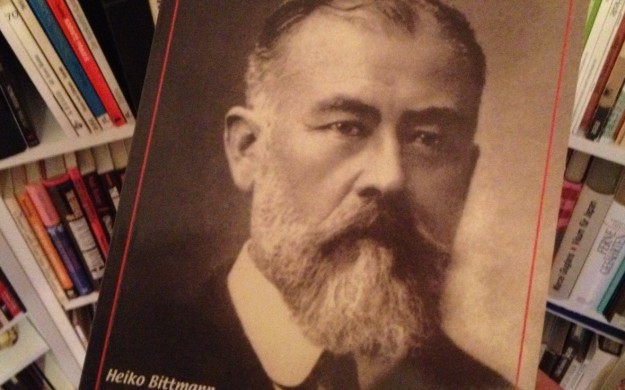
Erwin von Baelz (1848–1913) was a German doctor and, together with German surgeon Julius Scriba (1848–1905) considered a co-founder of modern medicine in Japan. Baelz came to Japan in 1876 as a so-called contract foreigner (お雇い外国人 o-yatoi gaikokujin). In addition to his work as a university professor, he worked in Japan as personal physician to the imperial family, anthropologist and researcher. Less well known is the fact that Baelz was an important advocate and promoter of traditional martial arts in Japan at the time. Sports scientist and Japanologist Heiko Bittmann, who lives in Japan, now explores this aspect in his work “Erwin von Baelz und die körperlichen Übungen. Leibeserziehung und traditionelle Kampfkünste im Japan der Meiji-Zeit“ (Erwin von Baelz and the physical exercises. Physical education and traditional martial arts in Japan during the Meiji period).
Heiko Bittmann is an active martial arts practitioner of various disciplines and has been writing about Japanese culture and the Japanese martial arts in particular for many years. He is one of the few authors who also draws on Japanese-language works in his hoplological research. His dissertation “Karatedo – Meister der vier großen Schulrichtungen und ihre Lehre. Biographien – Lehrschriften – Rezeption“ (Karatedo – Masters of the four major schools and their teachings. Biographies – Teachings – Reception), published in 1999, is an outstanding, scientifically sound work of historical martial arts research.
Published in 2010, his new book has eight chapters, is bilingual (German and Japanese) and available from the publishing house Heiko Bittmann. The translation and analysis of the numerous primary and secondary sources is supplemented by historical and contemporary images.
With his work, Bittmann aims to provide “as comprehensive an insight as possible into Baelz’s views, analyses and recommendations on physical education … as well as on the traditional martial arts of Japan … as has not been available to date.” (p. 11). He is also interested in answering the question of what “influence Baelz exerted on physical education and in particular on the traditional martial arts of Japan” (idem). The book is the first to include previously unpublished diaries from the period after 1905 as well as other manuscripts that have not been mentioned in previous Baelz research. In his explanations, Bittmann impressively demonstrates that Baelz “repeatedly refers to the necessity of physical exercises as a means of strengthening and maintaining the health of the body …” (p. 129). In this context, Baelz “continued to advocate the practice of traditional martial arts such as kenjutsu and jujutsu” (p. 130).
Conclusion:
Bittmann’s work is a unique and valuable contribution that describes not only the life and work of Erwin von Baelz and his influence on the Japanese martial arts, but also the situation of the Japanese martial arts at the end of the 19th century.


Leave a Reply