Sakamoto Manshichi (坂本万七, 1900–1974) was a distinguished Japanese photographer from Hiroshima Prefecture whose work is closely associated with ethnographic documentation. He developed a particular sensitivity for capturing folk crafts and Buddhist statuary—subjects that required both technical precision and an eye for cultural nuance.
In 1939, Sakamoto joined the research group led by Yanagi Muneyoshi (柳 宗悦, 1889–1961), which traveled to Okinawa to conduct ethnographic fieldwork. Yanagi’s group is perhaps best known for producing the documentary Ryūkyū no Fūbutsu 琉球の風物 (1940), which includes a brief but important glimpse of Okinawan karate. One scene shows group training at the Okinawa Prefectural Normal School under the guidance of Miyagi Chōjun (宮城長順, 1888–1953). Sakamoto also documented the filming itself with his camera, creating a parallel visual record to the documentary footage. His photographs from this period have been preserved and are now held in the collections of the The Japan Folk Crafts Museum in Tōkyō and the Okinawa Karate Kaikan in Tomigusuku, where they continue to serve as important primary sources for the study of Okinawa’s cultural and martial heritage.
During this stay, Sakamoto also photographed extensively across Okinawa as well as the Miyako and Yaeyama archipelagos. The resulting body of work offers a rare visual record of Okinawa on the eve of the Pacific War. Its value can hardly be overstated: much of what Sakamoto captured—architecture, objects, and everyday practices—would soon be lost in the devastation of the Battle of Okinawa.
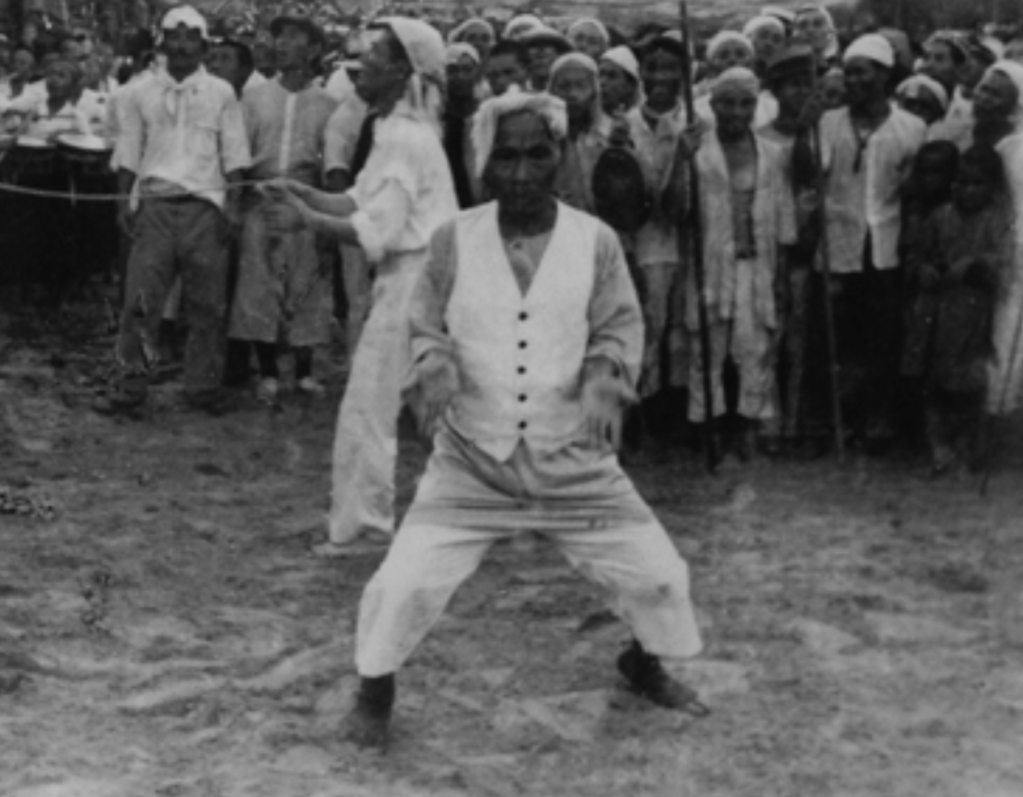
A notable example of his work is his documentation of the Yonabaru Great Rope-Pulling Festival (与那原大綱曳 Yonabaru Ōtsunahiki), captured during his stay. Preserved today in the collections of Yonabaru Town, these images reveal both the staged and the incidental dimensions of cultural performance. Particularly striking is a photograph taken at the margins of the official event: it shows a man apparently performing a sequence reminiscent of a karate kata. The image is catalogued as a karate demonstration (演舞 空手). The same collection includes a photograph that appears to depict practitioners of mura-bō (村棒, village staff).
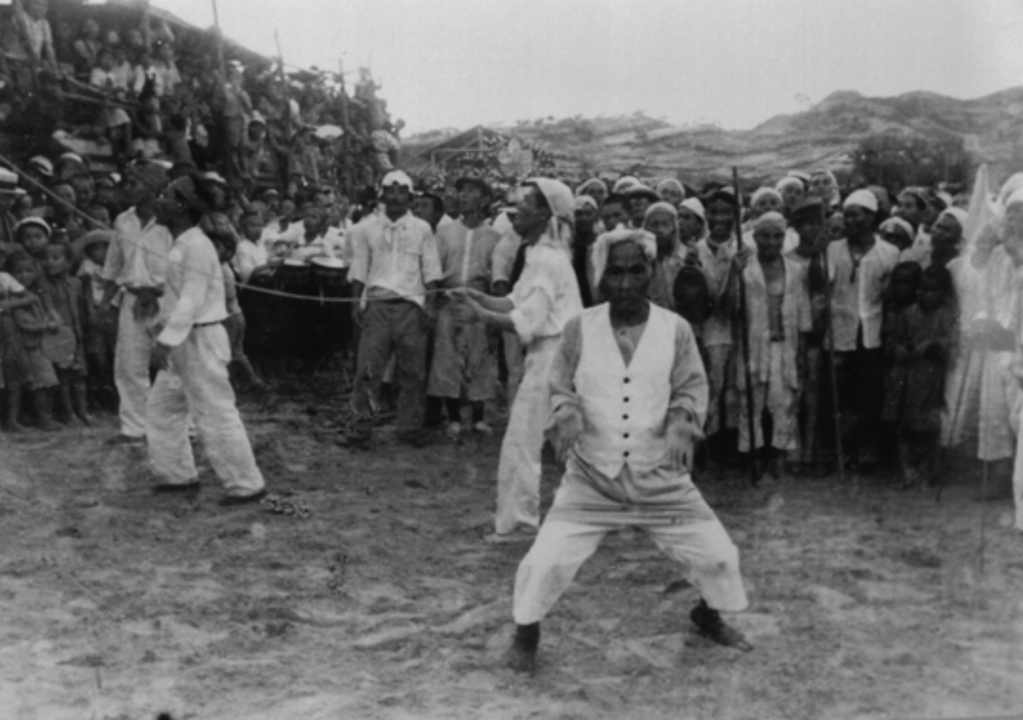
Old man performing a karate kata ? Source: Yonabaru Town
Taken together, Sakamoto’s images add to any overly narrow understanding of karate’s presence in pre-war Okinawa. They hint at a lived practice embedded in everyday settings—festivals, gatherings, and informal displays—rather than confined to institutional or staged demonstrations alone. In this sense, Sakamoto Manshichi’s work does more than document a disappearing world. It preserves fragments of embodied culture at a moment of transition, offering rare visual evidence for how practices like karate may have existed within the social fabric of Okinawan life before 1945.


