Gima Makoto (儀間真謹, 1896–1989) is one of the most important eyewitnesses to the early development of karate on the Japanese mainland. He is best known for assisting Funakoshi Gichin (1868–1957) during the historic karate demonstration at the Kōdōkan in Tōkyō in 1922. On that occasion, Funakoshi performed the kata Kūsankū, while Gima demonstrated Naihanchi.
Funakoshi selected Gima as his assistant, presumably because he was both a skilled practitioner and, as a fellow Okinawan, an appropriate representative of the art. During his school years, Gima had studied karate under Yabu Kentsū (1866–1937) and likely also gained at least some exposure to the teachings of the already elderly Itosu Ankō (1831–1915). On the Japanese mainland, he became one of the earliest karate practitioners to receive the rank of dan, achieving this distinction in 1924.
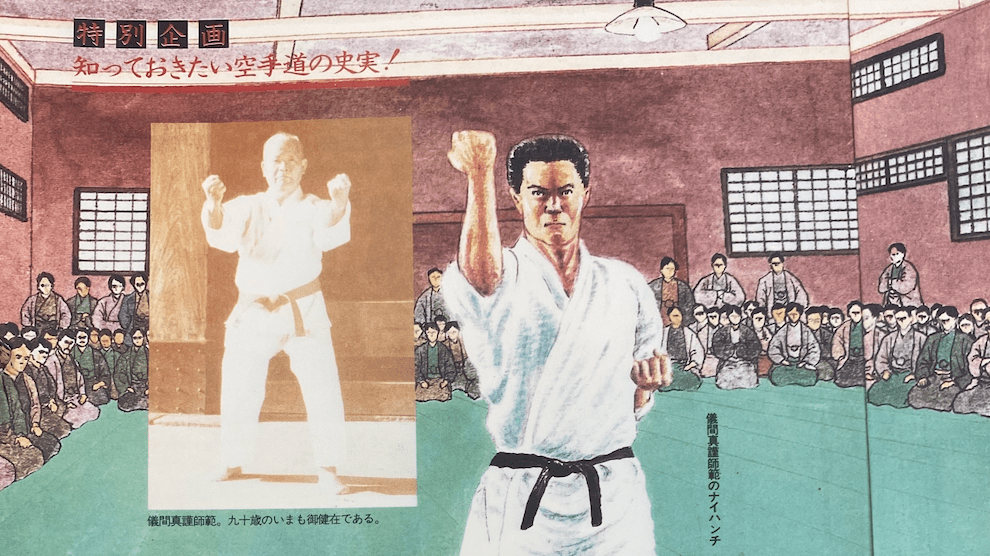
For historians, Gima’s greatest legacy lies in the numerous valuable firsthand accounts he left behind. These include his written recollections and several interviews, most notably a full-length interview volume published in 1986, which probably remains one of the most important primary sources on the formative years of modern karate.
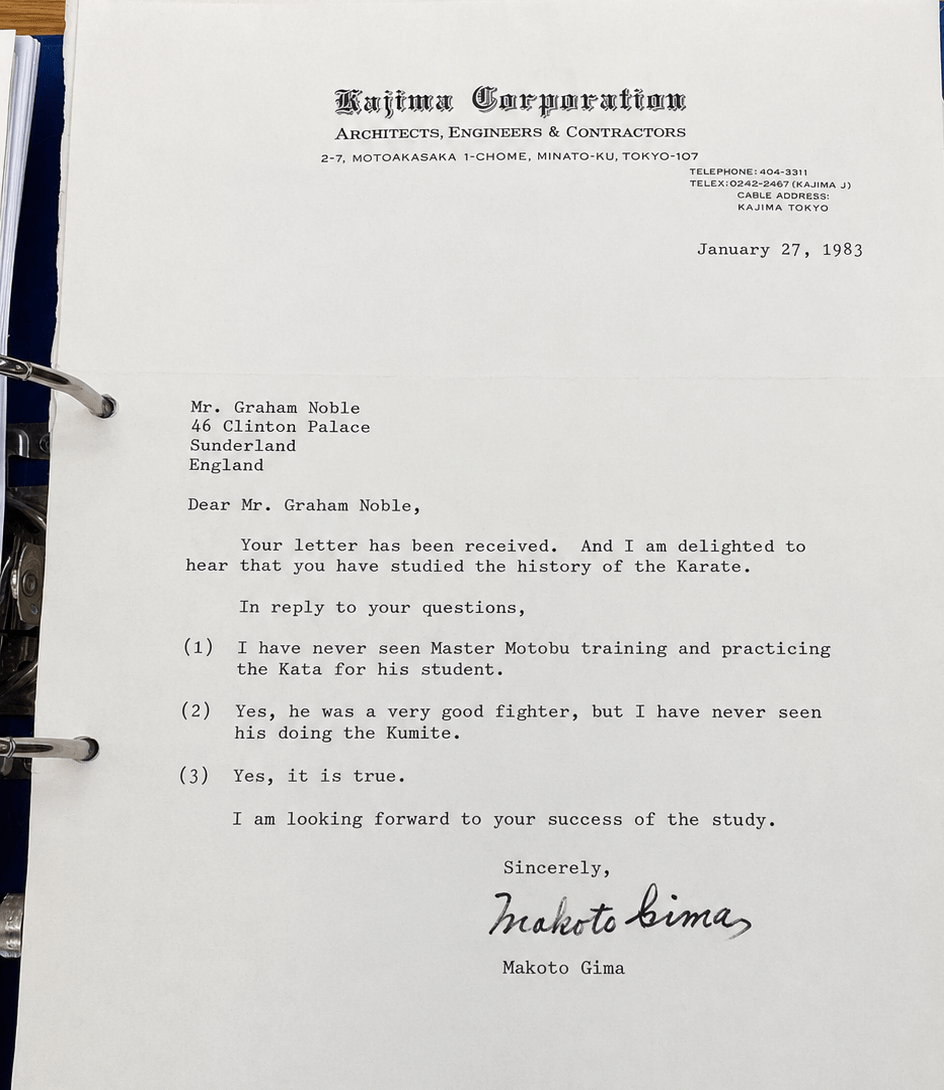
In addition, during his own research, independent researcher and writer Graham Noble once succeeded in conducting a brief written interview with Gima in 1983. Surprisingly, this exchange appears to have remained unknown in the existing historiography. Gima’s machine printed but hand-signed letter is dated 27 January 1983 and preserved today in the Graham Noble collection at Durham University.
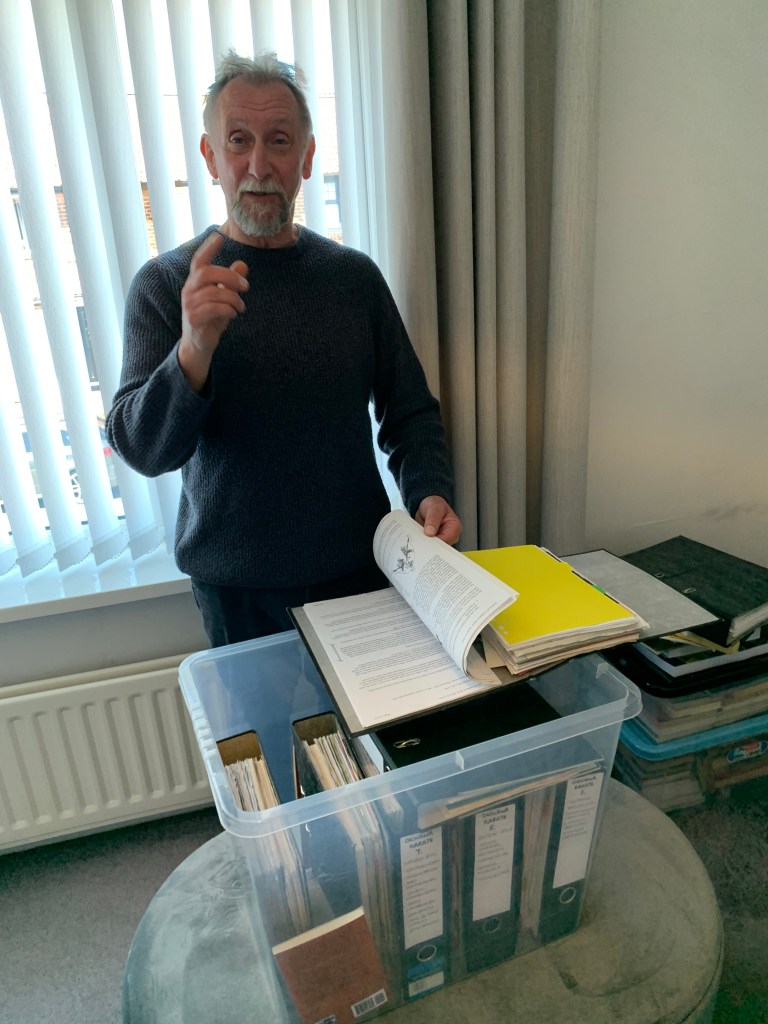
(23 April 2022)
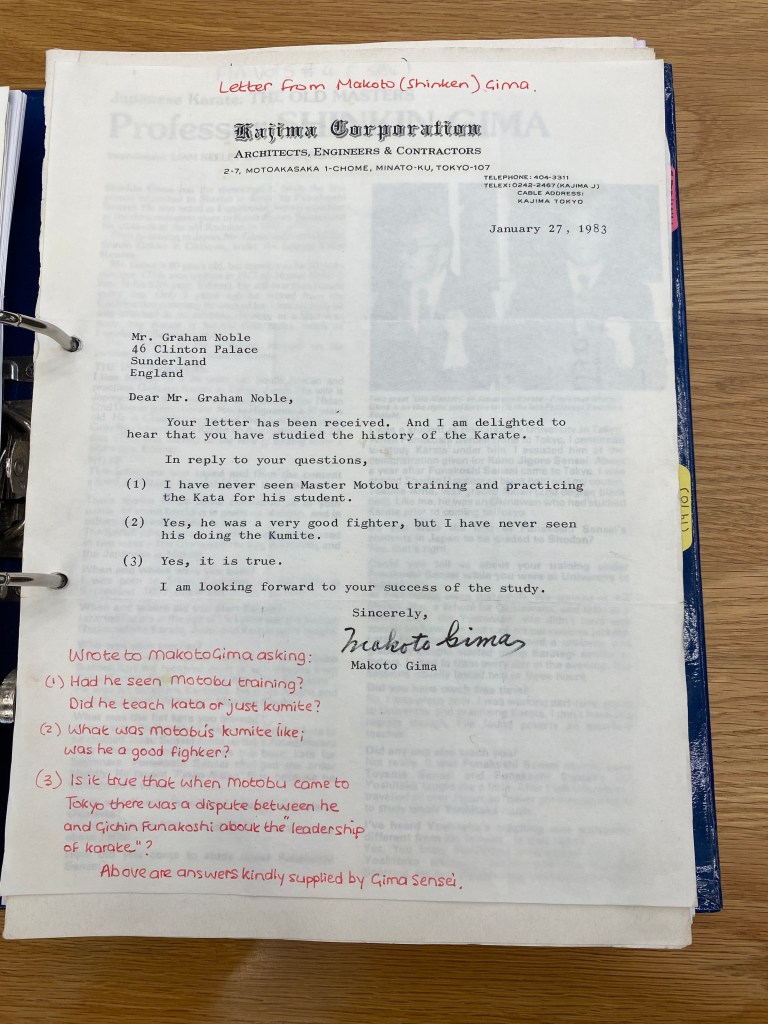
(24. April 2025)
Graham’s questions:
(1) Had he seen Motobu Chōki training? Did he teach kata or just kumite?
(2) What was Motobus kumite like; was he a good fighter?
(3) Is it true that when Motobu came to Tokyo there was a dispute between him and Funakoshi Gichin about the “leadership of karate“?
Gima’s answers:
(1) I have never seen Master Motobu training and practicing the Kata for his student.
(2) Yes, he was a very good fighter, but I have never seen his doing the Kumite.
(3) Yes, it is true.
Conclusion
Admittedly, Gima’s previously published recollections are significantly richer in historical detail. Yet that is not the point here. While preparing this article, Graham remarked about the document: “I don’t suppose the letter amounts to much, but it’s an interesting direct link with the past.” He is right. The letter is a rare, authentic testimony from one of the key eyewitnesses to karate’s introduction to mainland Japan. Its significance lies not in the amount of new information it contains, but in its very existence: it preserves another direct voice from a central figure in karate history and thus constitutes a small but valuable addition to the documentary record.
AI-enhanced image of the original letter used at the top, with handwritten annotations and the image showing through from a sheet underneath removed. The original letter is now archived at Durham University in the United Kingdom. I would like to express my sincere gratitude to Graham Noble for his continued support.

 Investigations into the history of karate