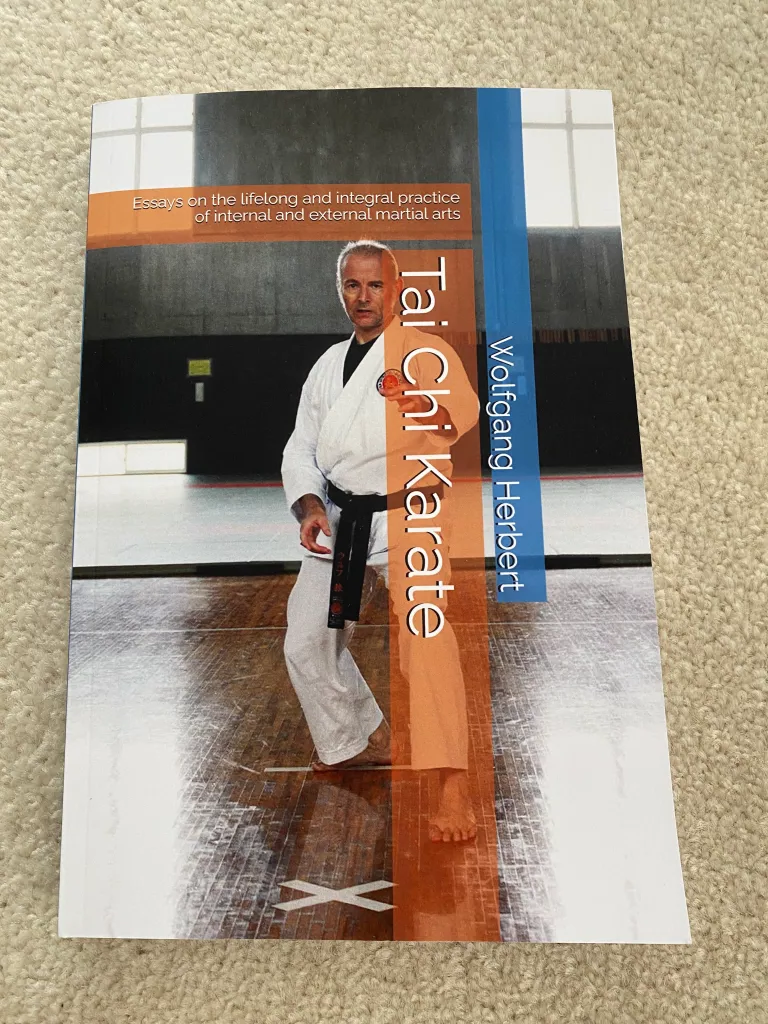
Wolfgang Herbert’s Tai Chi Karate: Essays on the lifelong and integral practice of internal and external martial arts continues the exploration begun in From Shaolin to Shotokan (2025). Combining autobiographical reflection, practical proposals, cultural criticism and historical discussion, the volume approaches karate as a transcultural practice whose physical, mental and spiritual dimensions deserve sustained attention. Herbert’s background in cultural anthropology and comparative religion, together with his extensive experience of living and training in Japan, informs this broad perspective.
A central concern is how principles associated with Taijiquan and Qigong might enrich karate practice and support continued training throughout life. Essays on standing meditation, the “seventy percent rule”, relaxation, and the reconsideration of kime and ki give this enquiry a practical focus. Even familiar elements, such as the ready posture and the formation of the fist, become occasions to reconsider established habits. The value of this approach lies in its invitation to examine how practitioners move, understand their bodies and adapt their training over time.
The collection also addresses the social and ideological environments in which karate is practised. Contributions on the cultic features of karate organisations, bushidō and the expression osu suggest a willingness to question conventions whose authority is often taken for granted. Read alongside Herbert’s advocacy of independent investigation and autonomous training, these subjects raise a significant issue: how can practitioners learn within a tradition while retaining the freedom to assess its assumptions critically?
An interview with Kanazawa Hirokazu (1931–2009) and a personal obituary add a further dimension, bringing personal encounters into dialogue with reflections on martial arts practice. The anthology’s varied formats thus allow practical, historical and institutional questions to be considered together.
Herbert’s proposals are best understood as an invitation to enquiry. His emphasis on curiosity, skepticism and experimentation leaves room for disagreement and acknowledges that an individual’s understanding of practice may change. For readers interested in karate as a lifelong discipline, the collection offers an engaging basis for reflecting on the relationship between inherited methods, personal experience and independent judgement.
Disclosure: The reviewer has collaborated with Wolfgang Herbert in various capacities. Herbert has also reviewed two books by the reviewer; both reviews are included in this volume.


